Free shipping on orders above $70
Cart (0)
Your cart is empty
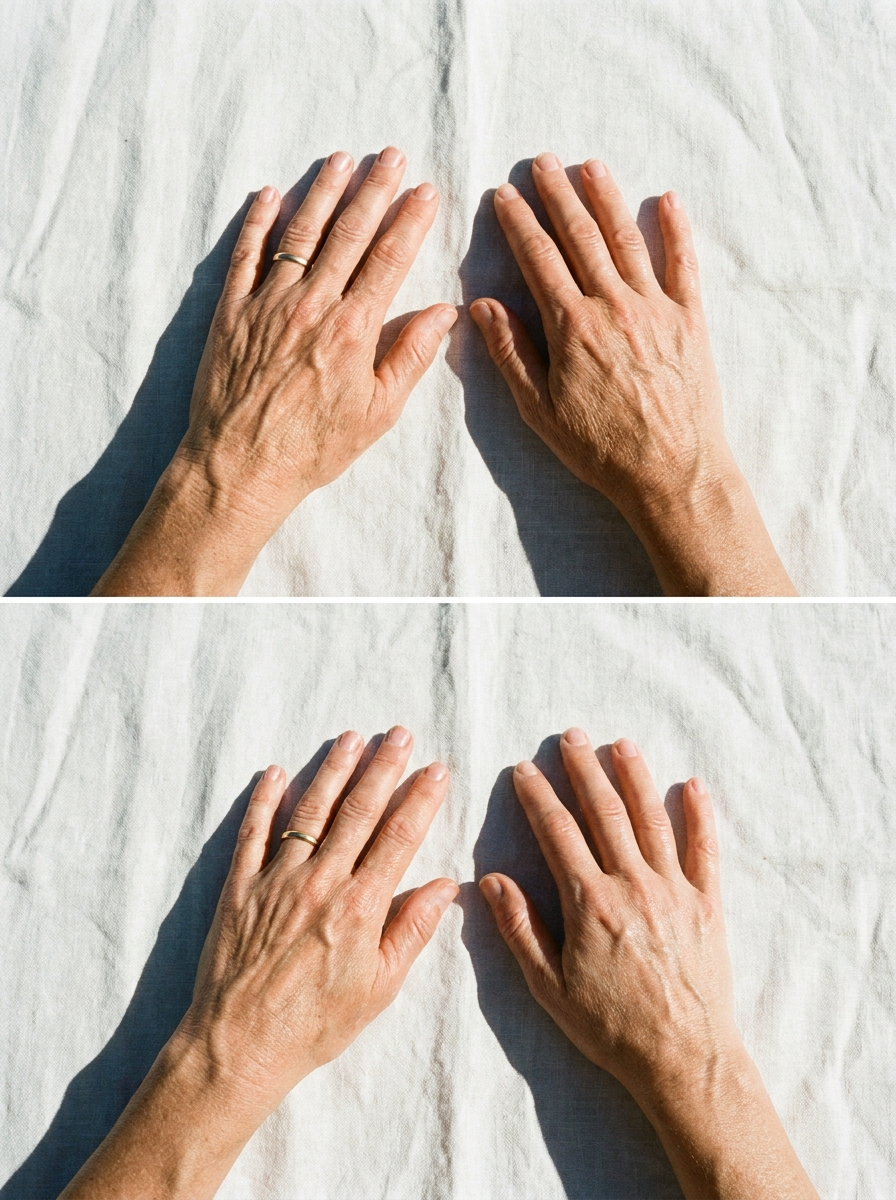
If the skin on the backs of your hands went crinkled and papery in a matter of months — not decades. If your face still passes for ten years younger, while your hands tell a different story entirely. If a doctor, a husband, or your own mirror has already delivered the verdict — that's just your age — and something in you refuses to accept it.
Then keep reading, because you are about to find out why the verdict was wrong, why every tube in your cream drawer was doomed before you opened it, and what French pharmacies have quietly stocked for this exact problem all along.
One line before we begin, because it reframes everything that follows: your hands didn't age. They stopped being fed.
In June, this journal published a reader's account of arms that changed "in one season" — and of the French esthetician who explained why. We expected a handful of replies. We received sacks of them. The largest pile, by far, wasn't about arms at all.
It was about hands. "My hands turned into old crepey hands overnight, and I am desperate." "I woke up with my mother's hands." "I never noticed how wrinkly my hands were until I tried to take a decent ring picture." Letter after letter, from women who could name the season it happened — and who had been told, every one of them, that it was nothing.
So we spent the summer reading every account, and we sat down with clinical aesthetician Anne Beaumont to ask the question the letters kept asking: why do hands fall first, why do they fall fast, and why does nothing in the drawer touch it? Her answers sort into six reasons. The sixth has a deadline attached, so don't stop at five.
The first thing nearly every letter did was apologize. Maybe I just never looked. Maybe I'm being dramatic. You weren't. When skin changes gradually, you adapt to it the way you adapt to a haircut growing out — you never get a shock. A shock means the change outran your eye. That is a different event, with a different cause.
The cause, in almost every letter we read, was the same: the hormonal change of midlife doesn't taper skin down politely. In many women it pulls the floor out in one season. Under the surface of young skin sits a kind of cushion — the fullness that keeps the surface smooth. Around the change, that cushion can thin faster than the surface can follow. The skin above it hasn't stretched and it hasn't dropped. It has simply lost what was holding it smooth from underneath — so it crinkles, like fabric with nothing behind it.
Your doctor called it aging because from across an exam room it looks like aging. Up close, it isn't the slow kind. And that distinction — slow versus sudden — turns out to matter more than anything else on this page.
Ordinary aging costs skin about one percent of its support a year. You'd never notice a year of that. What I see on these hands is two or three years of loss landing in a single season. When a woman tells me it happened overnight, she isn't exaggerating — she's the only one in the room describing it accurately.
— Anne Beaumont, Clinical Aesthetician
One letter put it in a sentence: "My hands look fifteen years older than the rest of me — I'm only in my forties." It feels like a personal betrayal. It's actually arithmetic.
The cushion under the skin of your hands was thin to begin with — thinner than your face, thinner than your arms. There was less to lose, so the same loss shows there first. Add to that everything hands endure that a face never does: washed a dozen times a day, in the sun every hour you're awake, never once wearing the sunscreen your face gets. When the change arrives and the cushion starts thinning everywhere, hands are simply the first place the fabric runs out of backing.
This is also why hands are the great tattletale. Readers wrote of faces that pass for thirty-five above hands that photograph like seventy — of husbands' careless remarks about "liver spots" that cut deep, of hiding hands in pockets at the exact age they should be reaching for things. If your hands aged ahead of your face, nothing went wrong with you. They were always going to be first. Nobody warned you, and that is the failure — not your hand washing.

"Lotion does nothing to improve it." We must have read that sentence, in one form or another, a hundred times. Here is the part nobody at the counter tells you: a cream is mostly water and wax. It lays a film on top of the skin, the film scatters light, and for an hour or two your hands look softer. Then you wash them — and on hands, you always wash them — and the film goes down the drain with the soap. The cream was renting you an appearance. It never once reached the layer that thinned.
The rest of the drawer fares no better. Firming creams tighten the surface film and touch nothing beneath it. The retinol that keeps your face young burns on the thin skin of the hands — several readers learned that the stinging way. And the cheap oil you may have tried once, the one that sat greasy on top until you crossed all oils off the list? Hold onto that memory. It matters in Reason Nº5, because what sat on your skin that day wasn't food. It was a raincoat.
The women who wrote to us were not careless. They were diligent — some heartbreakingly so, reapplying cream after every wash for years. Diligence was never the missing ingredient. The category was wrong.
One of the letters that stopped us came from a reader who spent eleven years working the counter of a pharmacy in Marseille before moving to Ohio. "When American friends visit," she wrote, "they ask where the body lotion aisle is. I have to explain there isn't one. There is an oil shelf."
She's describing a genuine cultural split. American women were raised to moisturize — to add water and seal it under wax. Frenchwomen were raised to feed — to give skin the oils it makes less of every year, especially after the change. Walk any pharmacy in France and the body section is glass bottles of oil, bought without ceremony by women of exactly the age reading this page, for exactly the problem on the backs of your hands.
Neither tradition is a secret. One of them simply never crossed the ocean. If you've spent thirty years moisturizing and your hands still went to crepe in a season, you weren't failed by your effort. You were handed the wrong tradition — and traditions, unlike windows, can be swapped in an evening.

Remember the cheap oil that sat on top? Here's why. Most inexpensive body oils are built on mineral oil — which is to skin what a raincoat is to a garden. It keeps things from escaping. It feeds nothing. Skin can't absorb it because skin has never met it.
A dry oil is the opposite animal, and one kept surfacing in the letters by name. Eraé Paris built its Rive Azur L'Huile the way the French pharmacy shelf demands: no water, no wax, no fillers — only four plant- and sea-derived oils chosen because midlife skin recognizes them as its own. Camellia, so close a twin to skin's natural oil that skin drinks it straight down instead of letting it sit. Bakuchiol, the botanical answer to retinol — the renewing effect without the sting that thin hand skin can't tolerate. Evening primrose, rich in exactly the fatty acid papery skin has stopped making. Sea buckthorn, the omega-7 that skin uses to rebuild from underneath.
You feel the difference inside a minute: it disappears into the back of the hand instead of gloving it, which is why readers reported typing, kneading dough, holding other people's babies minutes after applying. And because it feeds rather than films, the day's hand washing doesn't send it down the drain. Nadine — the esthetician from the account that started this mailbag — says it in one line: you cannot fill a cushion from the outside. You feed it — and not with water. With a real oil.
This is the reason we asked you not to skip, and the only urgency you'll find on this page — no countdown clocks, no stock theatrics, just biology.
The cells that rebuild the cushion don't die when the change hits. They go quiet. Anne Beaumont describes them as dormant — sitting at their stations, waiting to be fed and put back to work. The first year or two after the sudden change is when skin answers back the fastest; wait long enough and quiet becomes settled, and "reversal" becomes "management." The women still inside that window are, cruelly, the exact women being told it's too soon to worry — while the drugstore cream aisle quietly runs out their clock, two months of "give it time" at a stretch.
If you can name when your hands changed — last summer, between June and August, about a year ago — you are almost certainly still inside it. That's not a sales line. It's the single most useful fact in your situation, and it's the one your doctor's "just aging" erased.
Honesty here saves disappointment later. An oil feeds the cushion; it does not perform surgery. If your hands are mostly bony, with prominent veins and lost volume, no oil will re-plump veins — that conversation belongs with a doctor. Dark sun spots fade slowly at best. Swollen knuckles are a joint matter, not a skin one. What this oil addresses is the crepe — the crinkled, papery, tissue-paper texture riding on top — which, for most of the women who wrote to us, was the thing actually breaking their hearts.
Not sure which yours is? Do this tonight; it costs nothing. Pinch the skin on the back of your hand, hold five seconds, release. If it stands in a little ridge and settles slowly, that's the cushion talking — that's the fixable kind. Do it once a week and you'll have something no cream ever gave you: your own measurement.
And if you're still unsure after that — don't buy tonight. Run the pinch test for a week first. Being rushed by strangers is how your cream drawer got full in the first place.

Figures drawn from Eraé Paris' reader-letter review and its standing guarantee policy, summer 2026.

The dry French body oil for hands, arms and décolleté. Applied nightly after the last wash of the day — less than one firming cream that did nothing.
Check AvailabilityHere is the promise, spoken plainly. Use the oil on your hands for up to sixty days. If they don't feel like skin again — send it back, opened, half-empty, no forms, no questions, full refund. Sixty days. Even opened. On us.
Eraé can afford that promise for an unexciting reason: fed skin tends to announce itself, and most bottles never come back. One expectation, set honestly: some women feel the difference in a fortnight. Some take the better part of the sixty days. A few — usually those whose real issue is volume, not crepe — see little. That last group is exactly why the guarantee exists.
Thirty years as a dental hygienist — my hands have been washed raw since the nineties, and every cream I ever owned was gone by ten a.m. This is the first thing that was still there at the end of a shift. Because it's not sitting on top. Six weeks in, the backs of my hands stopped looking like tissue paper under the exam light.
— Pauline K., 57I crossed oils off my list years ago because of one greasy bottle. This one disappeared before I finished my coffee — no smears on my phone, nothing. And I did the math on my drawer: I'd spent over three hundred dollars on creams that did nothing. Fifty-nine felt almost sensible.
— Renee S., 54It had been almost two years since my hands changed, and after reading about the window I nearly didn't order — what was the point? Three weeks in, they were softer. They're not the hands in my wedding album, and they may never be. But they're mine again, and a partial return beats standing still with a drawer full of cream.
— Carol D., 61How fast will I see something? Honestly: it splits. Many women report softer, less papery hands within two to three weeks; others need most of the sixty days; a few see little. The pinch test each week will tell you which group you're in long before your eyes will.
Is it only for hands? No — it's one oil for every zone the change hits: hands, arms, décolleté, legs, neck. Most readers start with hands because hands are the zone they can't hide.
My hand skin is thin and reactive — the retinol I tried burned. That's precisely why the formula uses bakuchiol instead: the renewing effect of retinol without the sting, and without making sun-exposed hands more sensitive to light — which matters, because hands live in the sun.
What if it does nothing for me? Then it costs you nothing. Sixty days, even opened, no forms, no questions — send it back and the $59 comes back to you. The risk of trying sits with Eraé. The risk of waiting sits with the window.
Tomorrow your hands will be exactly where they are today: on the table at lunch, on the pew, on someone's shoulder, in the photograph you didn't know was being taken. The only question is whether they'll be in the light or curled in your lap.
You now know what your doctor didn't say: it came fast because the cause was fast, hands fell first because they were always going to, the cream was never trying, and the window that decides how much comes back is open — for now. Nobody can make that decision except the woman reading this. Tonight's application, or tonight's pinch test, is that decision. Make it on purpose.
THIS IS AN ADVERTISEMENT AND NOT AN ACTUAL NEWS ARTICLE, BLOG, OR CONSUMER PROTECTION UPDATE
THIS IS AN ADVERTISEMENT AND NOT AN ACTUAL NEWS ARTICLE, BLOG, OR CONSUMER PROTECTION UPDATE. This page contains sponsored advertising content from Eraé Paris. The accounts and letters described are illustrative of verified customer and reader experiences; names have been changed. Results vary from person to person and depend on the individual. This product is not intended to diagnose, treat, cure, or prevent any disease. If you have concerns about sudden skin changes, consult your physician.