
A Formulator of 19 Years Warns: Your Body Lotion Is Maintaining the Exact Skin It Claims to Fix
What's actually happening in the sixty seconds after you apply, the three label lines that explain your arms, and what a formula looks like when nobody writes a repurchase strategy into it.
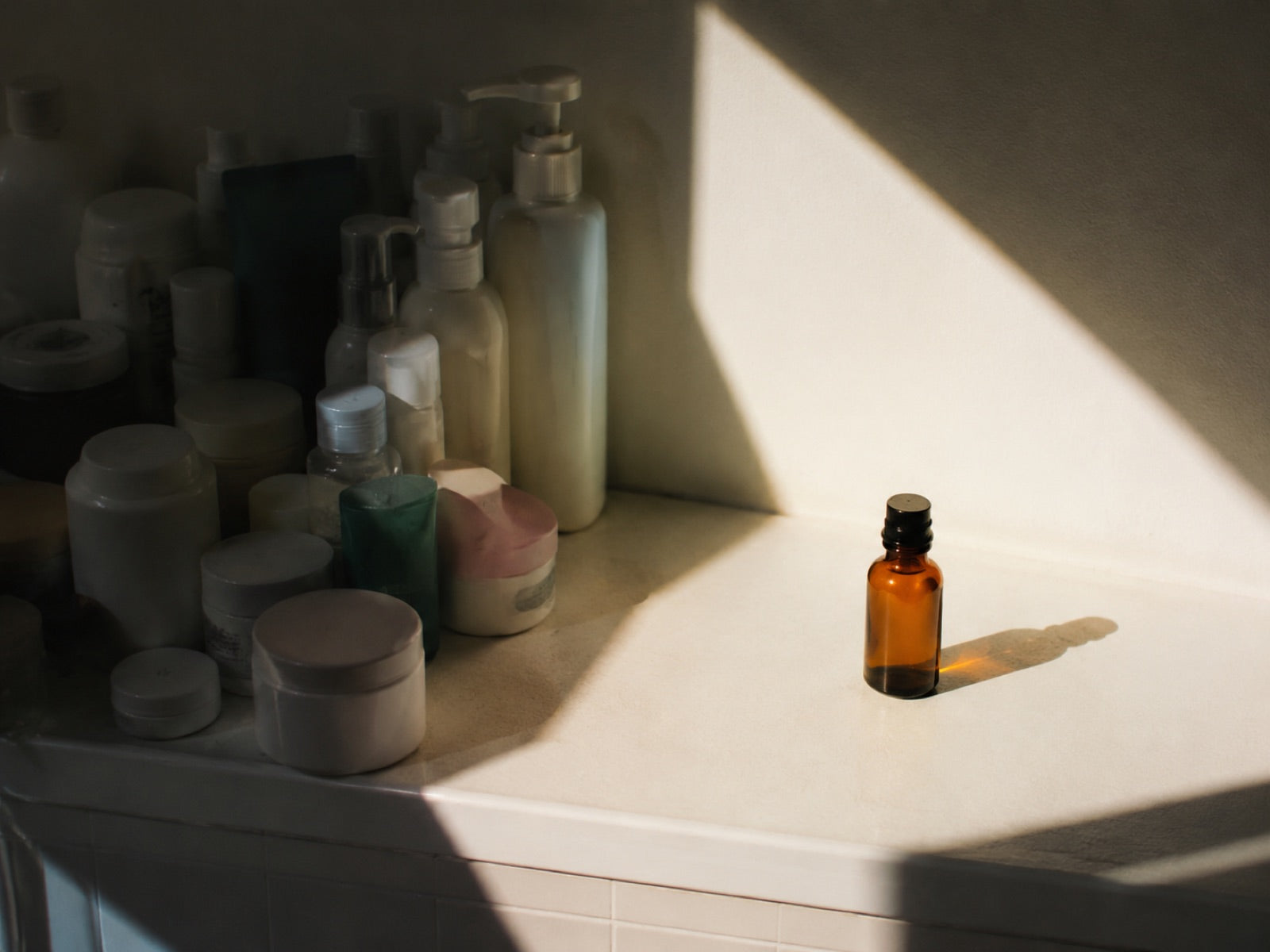
Everything below can be verified against the bottles already in your bathroom. That's the point of an audit: you don't believe it, you check it.
Every application is doing two jobs. Only one of them is for you.
I mixed body-care formulas for nineteen years, for brands whose bottles are in your bathroom right now. I left in March. Here is the audit I was never allowed to publish.
When you smooth on a body lotion, two things happen. The one you feel: water and silicones deliver an hour of softness. The one you don't: the formula finishes its actual job, which is to feel just good enough, briefly enough, that you reapply tomorrow and repurchase next month.
Nothing in that bottle is designed to change your skin. I know, because designing them was my job, and "change" was never once in the brief.
The water that leaves and takes your morning with it
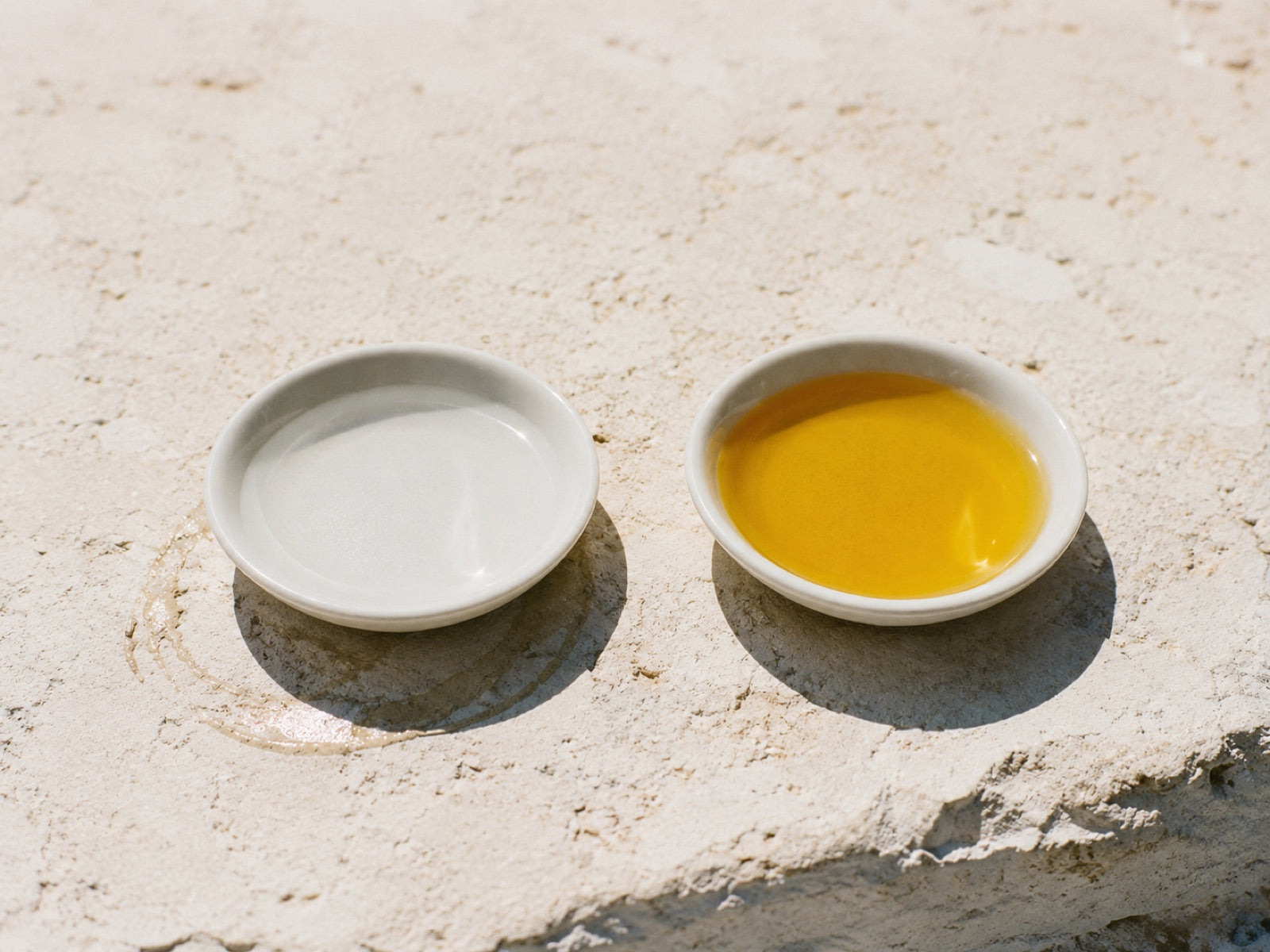
Water is the first ingredient in essentially every lotion sold in America because water is free and makes the bottle heavy. On skin, it evaporates within the hour. On post-menopausal skin, which has stopped producing its own oil, it evaporates from a surface with no lipid layer left to slow it down, which means the dryness returns faster than it did the day before.
You have noticed this. It's why the reapplying never ends.
The raincoat pretending to be an ingredient

Next on most labels: mineral oil or its cousins, paraffinum and petrolatum. Cost: pennies. Function: an occlusive film, a raincoat, that stops the water loss for a while by sealing the surface.
The raincoat feeds the skin nothing. Worse, on skin that's starving, it wears the costume of the exact thing that would help. Half the women who tell me "I tried oils, they don't work" tried mineral oil. That's not an oil in any sense your skin cares about. That's packaging you rub on.
The 'firming' claim is a film that shrinks as it dries
The tightening you feel from firming creams is real, measurable, and temporary in the most literal way: polymers dry on the surface and contract, like a coat of varnish, and the sensation lasts until water touches it.
In development, we called the effect by its honest name: instant perceivable benefit. It exists to be felt in the fourteen days of a typical return window. What it never did, in nineteen years of my sitting in the meetings, was change the skin underneath.
Four things skin after the change actually runs out of

Post-menopausal skin isn't mysterious. It's short exactly four things, and a formula built in good faith replaces them: renewal signaling without irritation, which is bakuchiol's job; the skin's own-type oil, which camellia matches almost molecule for molecule; omega-7 for suppleness, which sea buckthorn carries more of than any other botanical; and GLA, which evening primrose supplies after your body stops making enough.
No water to pad the bottle. No raincoat. No varnish. That formula exists now: it's called L'Huile Nº01, from a Parisian house called Rive Azur, and it's built the way French pharmacy oils have been built for generations, because that tradition never had a repurchase meeting.
The calendar, from someone with no reason to flatter it
Week one: absorption. It goes in, the surface stops shining, and the evening tightness quiets down. Week three: press your forearm; most women feel a slight resilience return. Weeks four to eight: texture visibly smooths, chest first, arms next, knees last, stubbornly.
Some skins run late, and a small number see little; biology keeps its own books. That's why the only honest guarantee in this category is one that outlasts the calendar: thirty days, opened bottle included.
Rive Azur — L'Huile Nº01. Built like the brief I always wanted to write.
SEE L'HUILE Nº01Since the switch
Self-reported results from customer surveys after eight weeks of twice-daily use. Individual results vary.
Thirty days. Even opened. On us.
A guarantee designed to outlive the honest calendar above. If a month of real feeding changes nothing on your skin, the bottle is refunded, used or not.
DISCOVER L'HUILE Nº01From women who read the audit
★★★★★Nineteen years in their labs and this is the bottle she left to make? That was enough for me. My arms agree six weeks later.
Maryanne D., 62
★★★★★The 'instant perceivable benefit' line explained every product I've owned since 1998. I felt seen and swindled in the same paragraph.
Vicki S., 58
★★★★★I switched my mother and myself the same week. She's 81. Her shins stopped flaking for the first time in years.
Paula N., 56
Fair challenges
Is this really written by a formulator?
It's an industry insider's account published by our journal, and every technical claim in it stands on its own: the label chemistry is printed on every bottle you own, and the film-forming behavior of firming polymers is standard cosmetic science. Check any claim against your own shelf; that's what the piece is for.
If lotions are designed this way, why does everyone sell them?
Because they work brilliantly at what they're designed for: feeling good immediately and costing almost nothing to make. The design brief is the problem, not a conspiracy. A formula with no repurchase strategy just needs a different kind of company behind it.
What's the risk of switching for a month?
Zero, structurally: thirty days, even opened, refunded in full without questions. The old routine, meanwhile, charges you every week and refunds nothing.
Your next application is a decision.
Tonight, after the shower, you'll reach for something. One option feels good for an hour and files its report to a repurchase model. The other feeds four things your skin stopped making, and shows its work inside a month, refundable in full if it doesn't.
You've made the first choice roughly ten thousand times. Once more, or once differently.