Free shipping on orders above $70
Cart (0)
Your cart is empty
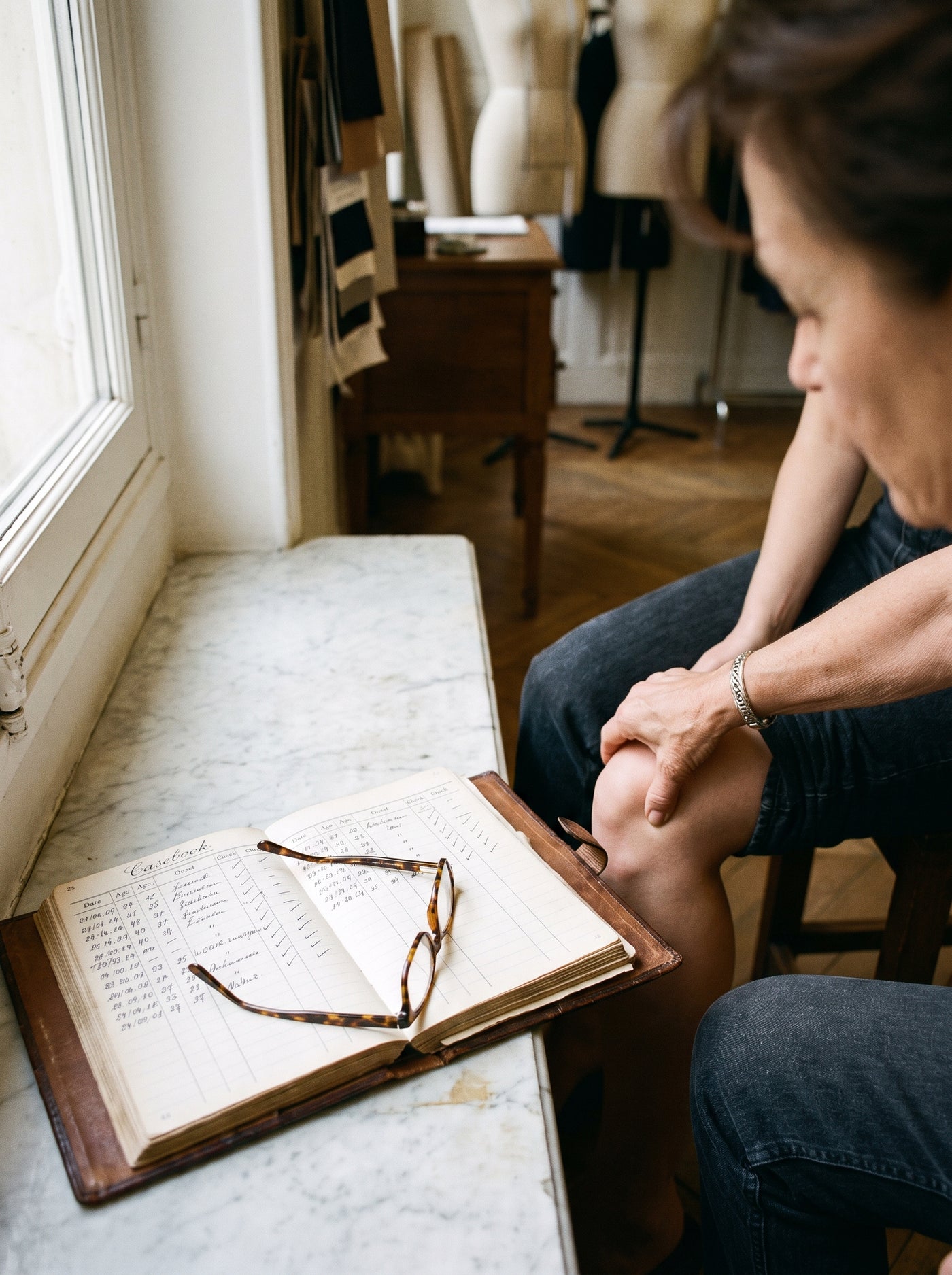
If your legs were firm two summers ago and now the skin from your knees up drapes and folds when you bend — if you've quietly rewritten your wardrobe around it, and a doctor waved it off in two seconds — the woman whose casebook I've spent the last month reading would tell you something your doctor almost certainly would not: you are probably not aging the way she thinks you are.
I write about women's health for a living, and I've grown allergic to the word miracle. What made me drive out to Anne Beaumont's small studio wasn't a claim. It was a ledger. She has kept one for thirty-nine years — a bound book with a column most estheticians never think to record. Not age. Not weight. The date the change began. And when you sort a career's worth of legs by that one column, a pattern falls out that contradicts what most physicians were trained to say.
Everyone records the age. Almost no one records the onset. But the onset is where the truth is hiding — because a leg that collapsed in one summer is not the same tissue as a leg that thinned over twenty years. They only wear the same face.
— Anne Beaumont, Clinical Aesthetician
Beaumont has heard the sentence so many times she can finish it for the woman saying it. It happened in one summer. A year ago I was fine. She hears it from bookkeepers and nurses and retired teachers, from women who ran 5Ks and women who never exercised a day. The one thing they share isn't a lifestyle. It's a timeline that doesn't add up — and a physician who never noticed the timeline was the whole point.

I asked Beaumont, plainly, why I should trust a book of handwritten notes over a doctor's diagnosis. She didn't argue. She handed me the book and let me read the entries myself.
Thirty-nine years in Paris, all of it menopausal skin. She did not set out to prove anyone wrong. She simply noticed, decades in, that two women the same age could have identical-looking legs and respond to completely opposite things — and the variable that predicted it was never their age. It was how fast the change had come.
So she started asking one question at intake, every time: When did this start? And she wrote the answer down. Slowly the book split itself in two. One group described a quiet drift over many years. The other described a cliff — a summer, a season, a few months after a hormonal marker fell away. Same age brackets. Same surface complaint. Two entirely different tissues underneath.
The medicine is not wrong about the slow kind. It is simply blind to the fast kind, because no one taught them to ask the one question that separates them.
— Anne Beaumont, Clinical Aesthetician
Here is the mechanism as Beaumont draws it, and I'm repeating her vocabulary exactly because she is precise about it. Beneath the surface of the skin sits what she calls the cushion — the padding that keeps the surface full and springy. The cells that keep that cushion topped up take their instructions from your hormones. When the hormones fall away, those cells go quiet. The cushion collapses. And the crepe you see on top is only the roof sagging with nothing left underneath to hold it up.
Slow aging loses roughly one percent a year — the quiet, even drift that makes an eighty-year-old's skin look the way it does. Sudden collapse is different arithmetic entirely: two or three years' worth of that loss crammed into a single season by the hormone shift. Not the same disease. The same face.
And legs, she is emphatic, are the cruelest place for it. Leg skin is far thicker than facial skin, so a cream has no hope of sinking down to the cushion layer. Worse, your legs carry your whole weight all day — the moment the cushion thins, gravity puts the loss on display. A face can hide this for years. Legs cannot hide it for a week.
Everything above merely explains the drape. This next part explains why the drape has a deadline.
Those quieted cells, Beaumont says, are asleep — not dead. But if they stay asleep too long, they forget the work. They set. And once they set, the cushion is gone for good: no cream rebuilds it, no laser rebuilds it, and surgery only trims the loose skin away without laying padding back underneath. You end up tighter, and emptier.
From the day the collapse begins, she puts the window at somewhere between eighteen and twenty-four months while the cells can still be woken. It does not open a second time. This is the entry in her casebook that stopped me cold — because next to a great many names, in a different color, she has written the onset date the woman first told her, and then the date she actually arrived. The gap between those two dates is, quite literally, the difference between rebuilt and permanent.
Because Beaumont records what each woman tried before she arrived, her book is also a graveyard of the things that don't work — and they fail, she says, for the same reason every time.
Pharmacy crepe creams and correctors. They soften the surface. The drape never budges, because the drape isn't on the surface. Fail.
Department-store firming and lifting serums. Same story, higher price. They sit on thick leg skin and rinse away before they reach anything structural. Fail.
Collagen-peptide thigh jars from social ads. Gorgeous before-and-afters that belong to someone else. The molecule never reaches the cushion. Fail.
Radiofrequency at the med-spa. Promises to 'tighten from within,' hundreds a session, thousands a course. It heats the surface layers; it cannot lay new padding beneath them. Fail.
The body-tightening laser package. Five figures, financing brochure included — and, as one clinic quietly admitted to a client in Beaumont's book, it 'softens but doesn't hold.' Fail.
Every one of them was built for the first kind of legs. Not one was built to get in and wake the cells before they set. That is not the woman's failure. It is the wrong tool for the wrong problem.

This is the inversion that took me an afternoon to accept. Products for slow aging are designed to protect and preserve what's still there, gently, over decades. But collapse isn't a preservation problem. You cannot protect your way out of a structure that has already fallen. You have to rebuild it — and you have to do it before the crew goes home for good.
Which is why the answer, Beaumont insists, has three non-negotiable requirements, and why two out of three is the same as zero.
All three, together, every day. Miss the first and the other two never get their chance — the cells never wake, the fats are never delivered. That, she says, is the entire reason the spreadsheets of failure look the way they do. It was never the ingredients. It was that nothing ever got in.
I pressed Beaumont on where a woman is supposed to find something that satisfies all three lines on purpose — because most of the market is still selling the first kind of answer to the second kind of problem. She told me the origin plainly, and I later confirmed it.
A French house set out to formulate not a firming cream but a body oil built specifically for hormonal collapse — light enough to reach the cushion, carrying bakuchiol to wake the cells, and sea buckthorn with evening primrose to put the stripped fats back. They call it Eraé Queen Oil, and they refuse to describe it as a moisturizer, because a moisturizer is precisely the tool that fails the first requirement. It is, as far as Beaumont has found, the only thing that answers every line of her list deliberately rather than by accident.
Anecdotes are cheap; a physician's two-second glance produced one. So I asked Beaumont for something heavier than a story. She let me pull a defined cohort from the book: women whose onset she had dated to within the last twelve months, who tested with a lingering fold of four seconds or more above the knee, and who used the oil daily and returned to be re-measured. Strict entry. No cherry-picking the easy ones.
Of the twenty women who met that criteria and completed twelve weeks, seventeen showed a measurable change on the same pinch test — the fold sinking back in under two seconds where it had held for four or more at intake. She had recorded both numbers, in ink, months apart. That is not a feeling. That is a re-measured column.
The feelings live in what they wrote to her afterward. One woman texted at 11 p.m. the night she wore a knee-length dress with nothing underneath it for the first time in over a year: 'I got in the car before I realized I hadn't thought about my legs once while getting dressed.' Another, after her first pool morning without the get-under-the-water-fast routine, wrote: 'I forgot it could feel like nothing.'
Reading the casebook alongside the formulation, six differences map cleanly onto the mechanism — and each one is why it belongs to the second kind of answer, not the first:
One — it's an oil, not a cream. Light enough to sink past thick leg skin and reach the cushion, instead of sitting on top and rinsing off. This is requirement one, solved.
Two — bakuchiol at the wheel. The plant that wakes the dormant cells with the retinoid effect, but without the burn on already-thin, fragile skin.
Three — sea buckthorn and evening primrose to refeed. Replacing the exact fats the hormone shift strips out, so the rebuilt structure holds instead of collapsing again.
Four — camellia japonica as the barrier. A sebum-mimic lipid the skin recognizes as its own, which is part of why it absorbs in about half a minute with no film.
Five — built for legs specifically. Formulated to defeat the one obstacle that defeats creams: the thickness of leg skin.
Six — the sixty-day promise. Full refund, no forms and no questions, which puts the only real risk squarely on the company's side of the ledger.

A French botanical body oil formulated for sudden hormonal collapse — light enough to reach the cushion, bakuchiol to wake the cells, sea buckthorn and evening primrose to rebuild. $59 per bottle.
Check AvailabilityI'll be candid about two clocks, because they run at once. The first is biological: your window is the eighteen-to-twenty-four months from when your legs began to change, and it does not reopen. The second is ordinary supply. Because the oil is made in small French batches and the practices that stock it are few, it moves in and out of availability — and a health publication larger than this one is running a feature on Beaumont's casebook shortly, which she expects to empty the current run.
The two clocks are the same problem. If you leave the page and it's out of stock when you return, there is no guarantee you're still inside your window when the next batch lands. That is the only urgency I'll press on you — not a sale, a calendar.
The window language frightens some women out of trying at all, which is the worst possible outcome, so let me put the guarantee against your specific fear. If you order and it turns out your cells have already set — if the drape doesn't fill — you send the bottle back within sixty days and you are out nothing but the shipping label. No forms. No questions. The company carries the risk of your window being closed so that you don't have to gamble your own money to find out. The only mistake with no refund attached is the one where you wait, and let the window close while you decide.
Set the numbers side by side, because they're almost embarrassing. The consultations these women had already paid for — the ones that ended in a financing brochure and a package that 'softens but doesn't hold' — ran into the thousands, some past five figures, for a result that cannot lay padding back beneath the skin. Against that, a bottle is $59, and a serious run is a small fraction of a single laser session. One tool is built for the collapse. The other is built for the drift and priced like a mortgage.
But the number that actually matters isn't dollars. It's the months. Every one spent rubbing another cream on the roof is a month subtracted from the only window you get. Most women don't run out of money in that window. They run out of time — and then arrive believing it only just began.
I had a whole drawer of firming serums, so I ordered this fully expecting it to join them. The difference was I could feel it go IN — thirty seconds and gone, no film on the sheets. By week two the fold above my knee sank back faster instead of holding. I pinched it every morning like a suspicious accountant. It wasn't a moisturizer. It reached something the others never touched.
— Barbara R., 57Mine went from smooth to draped, knees to hips, in one summer right after my last period. Everyone told me that's the worst kind. Twelve weeks in I wore capris to my grandson's baseball game and didn't think about my legs once. The speed of the collapse turned out to be the reason it responded — the cells were freshly asleep, not set.
— Colleen T., 60I found this at fifteen months in, terrified I'd missed the window. I'll be honest: I didn't get all the way back. But the drape on the fronts of my thighs filled partway, the crepe at the knee softened, and I can wear a skirt again without a second thought. My aesthetician said even partial recovery beats letting it set permanently — and she was right. I'd rather have most of my legs back than none of them because I was too scared to start.
— Ruth K., 54Beaumont keeps writing names in the book. The ones that haunt her are never the women who arrived too late — those she still helps to a partial return. They're the women who never sat down at all, who spent the whole window on the roof, and walked past the one thing built for their actual problem because a doctor's two seconds had already told them it was nothing.
Your legs changed in a season. That means you have the second kind. And the second kind has a clock.
THIS IS AN ADVERTISEMENT AND NOT AN ACTUAL NEWS ARTICLE, BLOG, OR CONSUMER PROTECTION UPDATE
THIS IS AN ADVERTISEMENT AND NOT AN ACTUAL NEWS ARTICLE, BLOG POST, OR CONSUMER PROTECTION UPDATE. The individuals depicted are real client accounts drawn from a working aesthetics practice; names and identifying details have been changed at their request. Results vary from person to person and are not guaranteed. This content is not medical advice, and Eraé Queen Oil is not intended to diagnose, treat, cure, or prevent any disease. Consult a qualified professional regarding your individual circumstances.