Free shipping on orders above $70
Cart (0)
Your cart is empty
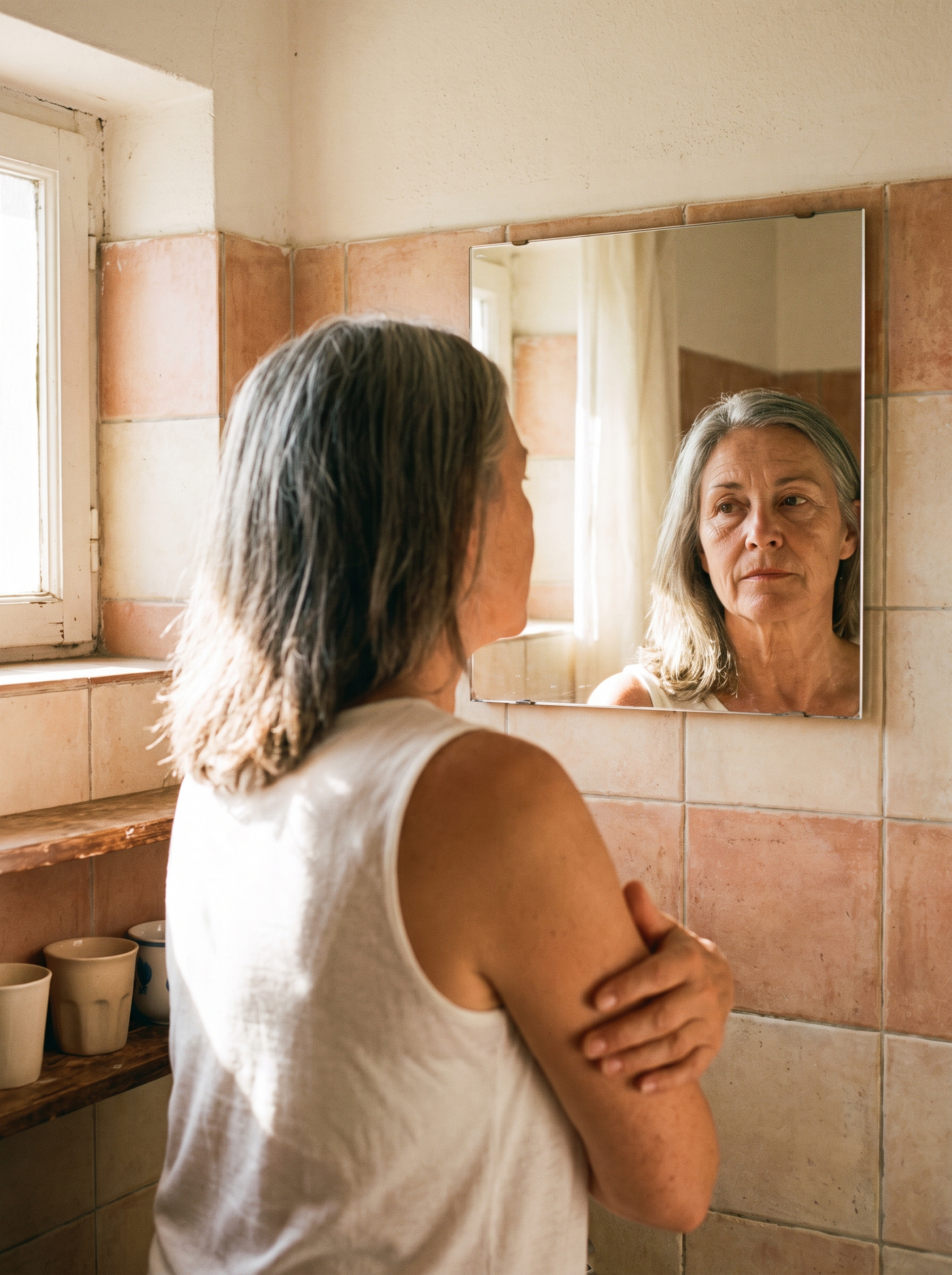
If the skin on your arms changed in months — not decades — this page was written for you. If a doctor has already said the words “just aging,” and something in you refused to sign off on that. If you have started the small, quiet workarounds — the cardigan in July, the edge of the group photo — read the next seven findings before you buy one more cream.
This spring, our editors did something unusual. We went inside the place where women compare notes after the appointments stop being useful: a French women’s skin community our readers kept mentioning. We read 217 threads, some running back four years. The same story repeats with different names. Skin that turned crepey in a single season. Arms, most often, first.
Seven convictions surface again and again in those threads. Not opinions — conclusions these women paid for, in years and in jars. Here they are, in the order the women themselves usually discover them.
The first thing the threads do is believe you. “It happened overnight.” “I was fine three months ago.” “I don’t recognize my own arms.” Outside the group, those sentences get a sympathetic nod and a shrug. Inside, they are a pattern — and the pattern has a name.
Almost every woman in those threads can name when it started. Last summer. Between June and August. About fourteen months ago. That precision matters. Gradual things don’t come with a date. Sudden things do.
We called Anne Beaumont, a clinical aesthetician who has spent her career with midlife skin, and read her a dozen of the posts over the phone. She didn’t hesitate.
Normal aging costs you about one percent of your collagen a year. Nobody notices a year of that. What these women describe is different — the hormonal shift can take two to three years’ worth of that cushion in a few months. I call it cushion collapse. It is not gradual, and it is not imaginary.
— Anne Beaumont, Clinical Aesthetician
Here is the strange two-beat the threads describe, over and over. A woman hears “it’s just your age” and feels relief — at least it’s nothing serious. Then, driving home, the refusal arrives: no. I was fine in the spring. Age doesn’t work like that.
The refusal is correct, and the doctor isn’t the villain. Dermatologists are trained to find disease — and crepey skin isn’t one. In a twelve-minute appointment, a slow one-percent slope and a sudden collapse look like the same thing: skin that isn’t what it was. The training has no box for “this happened between June and August.”
So the collapse gets filed under the slope. And a woman who was right about her own body walks out believing she was wrong. The threads exist because enough women refused to stay filed.

The angriest posts in the community come from the fittest women. Instructors. Daily walkers. Women who did everything right and watched the skin change anyway — while a sister who never exercises stays smooth. It reads like injustice. It’s actually anatomy.
Muscle lives under the cushion. The cushion itself — the collagen and the skin’s own oils that keep the surface plump and lit — runs on estrogen, not on repetitions. When that supply shuts off like a tap, no workout on earth reaches the layer that collapsed.
You did nothing wrong. You were strengthening one layer while another one quietly lost its funding. Two different systems. Two different fixes.
Nearly every woman arrives in the threads with the same inventory: a drawer of body creams, each one loved for a week. The community’s verdict on the category is blunt — one member’s phrase gets quoted like scripture: “a glorified moisturizer and nothing more.”
The mechanism is kitchen-simple. Most creams are water held against the skin by a light film. The film flatters for an hour — it scatters light, the crepe softens, you feel hopeful. By lunch the water is gone, the film is gone, and the skin underneath is exactly as unfed as it was at breakfast.
Honesty requires a hedge here: we can’t claim every jar on your shelf was useless. Some of them hydrated honestly. But hydration is weather. Collapse is structure. You were sold weather reports for a structural problem — which is why nothing “worked,” and why that was never your fault.
The threads police their own miracles, and so will we. If your arm skin hangs in loose folds — after major weight loss, for instance — that is lost volume, and it is a conversation for a physician, not an oil. No honest product claims otherwise.
What an oil can address is the texture riding on top: the crepe, the papery finish, the pinch that lingers instead of springing back. That is the collapsed cushion — and the cushion, as you’re about to read, is the part with a deadline and a lever.
If your problem is folds, stop reading and book the appointment. If your problem is crepe, keep going.
The turning point in almost every thread is the same question, asked by an American member to the French ones: what do you actually use? The answer starts with a shelf, not a product.
Walk the body aisle of a pharmacy in Lyon or Bordeaux and you’ll notice what’s missing: the wall of cream tubs. In its place, oils. It is a different philosophy, absorbed from mothers and grandmothers — American women moisturize; Frenchwomen feed. Water on top, versus oil into the structure.
And it maps perfectly onto what actually happened at fifty-one. When the hormonal tap shuts off, the skin stops producing its own oil — the very thing that kept it supple. A skin that stopped making oil does not need more water under a film. It needs the oil replaced. The French aisle knew this before the science could spell it.

When the French members explain what a sudden-collapse skin actually needs, they describe three moves, in strict order. First, wake the renewal that went dormant. Second, shield the surface with a lipid the skin recognizes as its own, so the new work isn’t lost. Third, rebuild — put back the exact fats the shift stripped out.
The order is the whole game. Wake without shielding and you get irritation — every woman who quit retinol knows that sting. Shield without feeding and you’ve reinvented the film. Only all three, stacked, move the cushion.
In the community’s shorthand, the ideal bottle has a short, non-negotiable list of demands:
Different women, different countries, different budgets — and yet when the three-move logic gets discussed, one bottle keeps surfacing by name: the Eraé Queen Oil, from Eraé Paris. Not because it’s fashionable, but because it was composed backwards from exactly this problem — four plant-and-sea heroes arranged as three phases in a single oil. Bakuchiol to wake. Camellia to shield. Sea buckthorn and evening primrose to rebuild.
The ritual the women describe is almost domestic in its smallness. At night, a few drops warmed between the palms, worked up the arm from wrist to shoulder. Two minutes. Several posters admit the two minutes became the point as much as the oil — one moment of the day that belongs to no one else.
We ordered it the way anyone would, from the brand’s own site. What we can verify is on the label and in the policy below. What the threads report is in their own words — three of which we’ve reprinted further down.
This is the finding that reorganizes everything else, and it’s the reason the threads are gentle with newcomers but firm about time. When the collapse is sudden, the cells that build the cushion go dormant — not dead. Anne Beaumont puts the working window at roughly eighteen to twenty-four months from onset: “Asleep can be woken. You simply cannot wait forever to do the waking.”
That is the only deadline on this page. No countdown clocks, no “last chance” theater. Just a biological fact that makes “I’ll deal with it next year” the most expensive sentence a woman in month ten can say.
And here is something to do tonight, free of charge. Press your thumb firmly into the skin of your upper arm for three seconds. Release. Count how long the mark lingers. Four seconds or more, and the cushion is talking to you. Women in the threads re-run this test after weeks of the ritual and post the new count — under two seconds is the number they celebrate.

Window and collapse figures as explained by clinical aesthetician Anne Beaumont in an interview for this article; guarantee terms per Eraé Paris published policy.

Most women in the threads ran the ritual for a full season before judging it. The multi-bottle options exist for one reason only: the rebuild is measured in months — the same unit as your window.
Check AvailabilityThe policy deserves plain language. Use the oil for a month. Run your own pinch test, on your own arms, in your own mirror. If you don’t like what you count, send the bottle back — opened, half-empty, it doesn’t matter — and the money comes back. Thirty days. Even opened. On us.
The brand can afford that sentence for an unromantic reason: women who feel the pinch quicken keep the bottle, and they’re the overwhelming majority. The returns are rare enough to price in.
And the honest version of expectations, from the threads themselves: some women notice the change in weeks. Some need the full season. A few see little — and that last group is exactly who the thirty days were written for.
I had a drawer of creams that ‘worked’ until noon. This was the first thing my skin didn’t just wear — it drank it. Six weeks in, I did the pinch test on my upper arm. Two seconds. I stood in the bathroom and did it again just to be sure.
— Karen S., 57I stopped waving years ago — you learn to keep your arms close. My nephew’s wedding was in October and I wore the dress with nothing over it. At the send-off I waved with both arms, high, like everyone else. Nobody noticed. That’s the point. I finally wasn’t the thing to notice.
— Marta L., 61I found all this at month twenty-one and almost didn’t bother — I was sure I’d missed my window. Asleep is not dead, it turns out. It’s slower for me than for the others, I won’t pretend otherwise. But my pinch went from five seconds to three, and for the first time my arms are coming back instead of going further. Direction matters more than speed.
— Ruth P., 63How fast will I see something? Honestly: it splits. Some women report the pinch quickening in a few weeks; most describe a season; a few see little. The thirty-day guarantee exists precisely because no one can promise you which group you’re in.
My legs and décolleté changed too. Same ritual? Yes. The collapse is systemic — arms simply tend to show it first. Women in the threads work the same two minutes on legs, chest, and the backs of the hands.
Retinol wrecked my skin once. Is this the same thing? No — that’s the reason bakuchiol is the hero here. It wakes renewal without retinol’s sting or sun sensitivity, and the camellia shield exists specifically so the waking never happens on an unprotected surface.
What if it simply does nothing for me? Then it costs you nothing. Thirty days, money back, even on an opened bottle. Run the pinch test the day it arrives, write the number down, and test again at day thirty. Let your own arm be the judge.
One more thing before you go, and it’s the opposite of a push: if you feel rushed, close this page. Pressure is a film too — it flatters for an hour and feeds nothing. The women in those threads didn’t convert anyone; they just kept posting their pinch counts until the counts spoke for themselves.
So do the free thing first. Tonight, press your thumb into your upper arm and count, honestly. Then count something else: the months since your skin changed. If you’re inside the window, you have a lever most women never learn exists — and a clock most women learn about too late.
Tomorrow morning you will look up from the sink into the same mirror. That part isn’t optional. What the mirror shows next season is. Two minutes tonight, or another month of cardigans — both are decisions. Only one of them has a deadline.
THIS IS AN ADVERTISEMENT AND NOT AN ACTUAL NEWS ARTICLE, BLOG, OR CONSUMER PROTECTION UPDATE
THIS IS AN ADVERTISEMENT AND NOT AN ACTUAL NEWS ARTICLE, BLOG, OR CONSUMER PROTECTION UPDATE. This page is Sponsored Advertising Content published on behalf of Eraé Paris. The accounts and community descriptions above are illustrative of reported customer and community experiences. Results vary from person to person and are not guaranteed. This product is not intended to diagnose, treat, cure, or prevent any disease. If you have a medical concern about your skin, consult a qualified physician.