Free shipping on orders above $70
Cart (0)
Your cart is empty
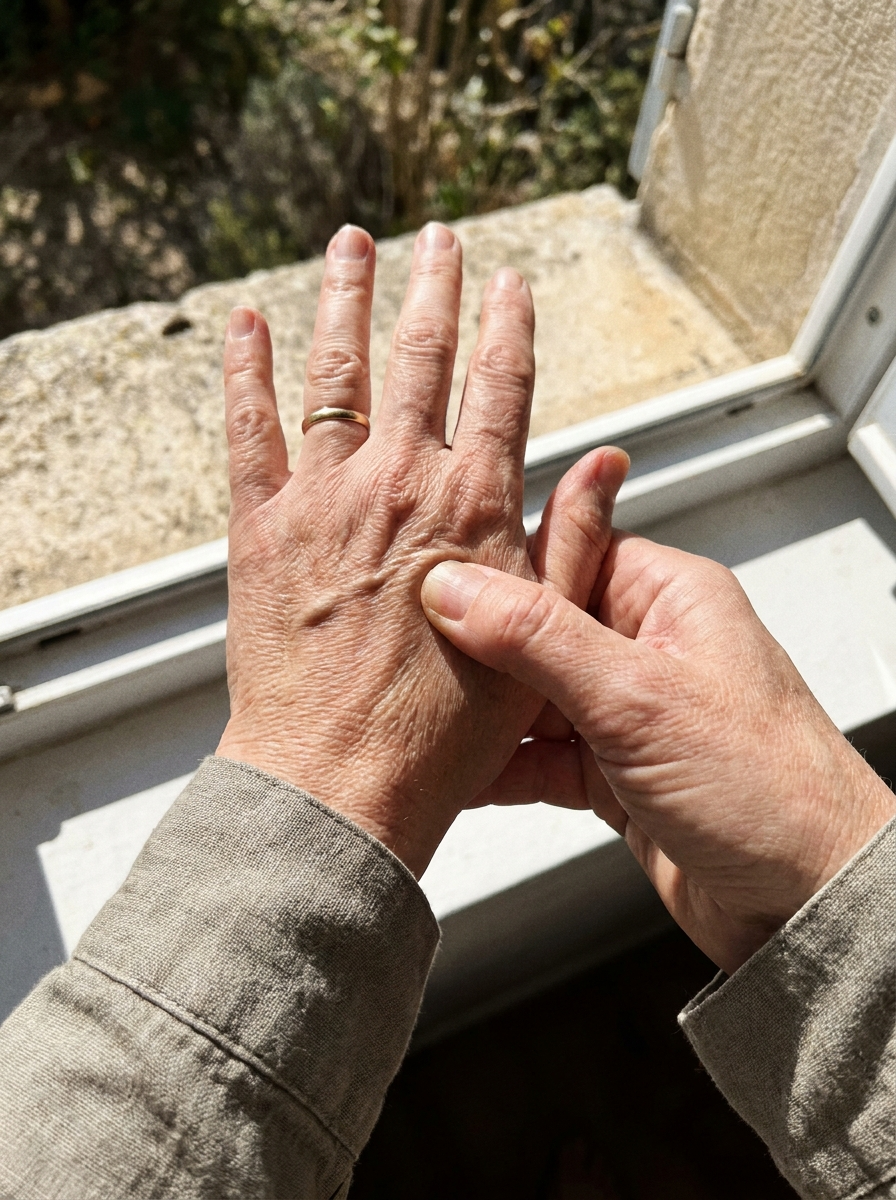
If the backs of your hands changed in one season — not one decade — this page was written for you.
If you have started hiding them: under the table at dinner, inside your sleeves at the school pickup, out of frame in the photo with the ring. If someone you trusted has already told you that's just age — and something in you refused to accept it.
Then stay for the next seven reasons. They came out of forty-three reader letters our desk received since April, all describing the same impossible thing. And they end somewhere most of those letters did not expect: with a way back.
One frame holds everything below. Your hands did not age. They ran out of something.
Aging is a slope — slow, even, twenty years long. What these women described is a step. A fall. Those are different events, and they call for different answers. We sent the whole folder to Anne Beaumont, a clinical aesthetician who has spent years working with women whose skin changed suddenly rather than slowly. She read every letter. Her verdict, in one line: "These women are not describing aging. They are describing a collapse. And a collapse can be answered."
The letters do not say "my hands slowly got older." They name a moment. "My hands turned into old crepey hands overnight, and I am desperate," one reader wrote. Another: "They changed to my mom's hands overnight." A third was typing at her desk, looked down, and did not recognize what she saw.
Here is what nobody tells these women: the suddenness is not in their imagination, and it is not vanity. It is information. Ordinary aging does not move that fast — it can't. When the texture of your hands changes across a single summer, a single pregnancy, a single year, something specific happened. Anne calls it cushion collapse: the hormonal shift pulls the support out from under the skin all at once, and the thin skin on the backs of the hands is the first place the fall shows.
You were not being dramatic. You were being observant. That distinction matters, because a woman who thinks she imagined it stops looking for an answer.
The mailbag had a chorus, and it was this: "My hands look ten years older than my face." Over and over. Women who are told they look young for their age — until someone glances down.
The reason is not mysterious. Your face gets everything: the serum, the sunscreen, the evening ritual, the good light. Your hands get whatever is left on your palms. Meanwhile they live the hardest life of any skin you own. They are washed a dozen times a day, and every wash strips the thin film of oil the skin makes to protect itself. They take the sun through the windshield on every drive. They meet the dish water, the sanitizer, the winter air.
So when the collapse arrives, your face has reserves. Your hands have none. They fall first not because they aged faster — but because they were defended least. One reader, a former waitress, put it plainly: years of hand washing, and hands that read a decade older than the woman attached to them.

The second pattern in the letters is quieter and crueler: the shrug. A dermatologist who chuckled. A doctor who said "part of aging" and moved on. A husband who joked about liver spots and never knew how deep it cut. One reader summarized what dozens implied: "My doctor was very dismissive and just said it was an age thing."
But listen to the logic. "Just age" describes a twenty-year slope. It cannot explain a single summer. When a woman says I was fine three months ago, she is handing her doctor the most important clinical detail in the room — the timeline — and the timeline is exactly what the shrug ignores.
The ad that may have brought you here told the story of a woman whose sister-in-law, a dermatologist, finally said the true thing: when it changes that fast, it's not just aging — you have to nourish it differently. Anne has been saying a version of that sentence for years. The letters in our folder are what happens when nobody says it in time.
Ordinary aging is a slope. What these letters describe is a step — a fall. When skin changes that fast, it is not 'just age.' It has to be nourished differently, and it has to be nourished soon.
— Anne Beaumont, Clinical Aesthetician
"Lotion does nothing to improve it." That line, or its twin, appeared in more letters than any other complaint. Women with drawers full of creams. Women who applied them faithfully, morning and night, for years — and watched nothing change.
Here is why, in kitchen terms. A cream is mostly water, held against the skin by a film. The film is a glove: for an hour or two, the surface looks smoother, the way anything looks smoother under a glove. But underneath, the skin is starving for the exact thing the collapse took away — lipids, the oils it used to make for itself. Water on top of a lipid problem is a kindness, not a correction.
Understand what this means about you: you did not fail those creams. Those creams were never built for what happened to your hands. An entire aisle handed you the wrong tool, and then let you believe the failure was yours.

One of the forty-three letters came from a reader who spent last October with her son's family in Paris. She went looking for hand cream in her daughter-in-law's bathroom and couldn't find any. There was an oil by the kitchen sink and another on the nightstand — and that was the entire hand-care regime of a woman with the hands of someone fifteen years younger.
She wasn't an exception. Walk the body aisle of a French pharmacy and the shelf is oils. It reflects a difference in belief so old nobody in France thinks to explain it: American women moisturize. Frenchwomen feed. Skin is made of lipids, so you give it lipids — food it recognizes — not water held down by a film.
You already half-believe this. It is why "French skincare" carries the reputation it does. The surprise is only that the belief was never about the face. It was always about the body — and nowhere does it matter more than the two places you wash twenty times a day.
If cream is a glove, what does feeding actually look like? Not one miracle ingredient. A sequence — three jobs, in order.
Wake. After a sudden collapse, the skin's renewal machinery goes quiet. Bakuchiol — a plant extract — nudges it back to work: the retinol effect, without the sting and without making thin hand skin more vulnerable to the sun it meets on every steering wheel.
Shield. Camellia japonica seed oil is a near-twin of the oil your skin used to make for itself. It restores the film your hands lose at every wash — but as food the skin recognizes, not a glove sitting on top.
Rebuild. Sea buckthorn brings omega-7; evening primrose brings GLA — the specific lipids midlife strips out fastest. This is the slow part, and the part no water-based product can even attempt.
Four plants. Two to three minutes a day, on the backs of the hands, after the last wash of the evening. Nothing complicated — which, after the drawer of complicated failures, is rather the point.
Here is the part of Anne's review that made us publish this piece now rather than in the fall issue. The cells that rebuild your skin's cushion do not die when the collapse comes. They go dormant. Dormant is not dead — but dormancy deepens. In her experience, skin answers fastest when the feeding starts within roughly a year and a half to two years of the change. After that, it still answers. Just more slowly, and sometimes not all the way.
The letters that were hardest to read were from women who had waited a decade, because everyone told them there was nothing to do. The ones that were easiest were from women who moved while they were still angry.
So do one thing tonight — it costs nothing. Press the back of one hand with your thumb for three seconds and let go. Count how long the print lingers. If it holds for four seconds or more, that is the cushion talking. Write down the number and the date. Whatever you decide after this page, that number is your baseline — your evidence, not our words.
Before we name the bottle the letters kept naming, honesty. An oil will not shrink prominent veins — those are circulation and anatomy, not skin. It will not slim knuckles or reverse joint changes. Deep, established sun spots are pigment territory: they may soften slowly, or they may be a dermatologist's job. And if skin hangs loose after significant weight loss, that is a volume question — a doctor should hear it first.
What feeding addresses is the crepe riding on top of all of it: the tissue-paper finish, the fine cross-hatching, the print that lingers after a press. We also cannot promise your hands at 58 will photograph like your hands at 38 — nobody honest can. But read the letters again and notice something: the veins were never really the wound. The texture was. The texture is what made women hide their hands, and texture is the part that can be fed.
We did not go looking for a product. The product kept arriving in the mail. Some readers heard about it from a sister-in-law who happens to be a dermatologist. One heard about it from her manicurist, who noticed the change before she did. The name that kept surfacing was Eraé Paris — specifically Rive Azur L'Huile, a dry body oil.
When we looked into it, the reason for the pattern became obvious: the house built this oil on exactly the premise this article has been arguing. Not "anti-aging." Not a firming film. It was designed for skin that changed suddenly — the wake, shield, rebuild sequence, carried by the four plants named above and nothing else you need a chemistry degree to pronounce. A dry oil, meaning it sinks in rather than sitting; you can type, cook, and hold a book without leaving prints on everything you touch.
And here is where we will step back rather than push. A stranger's enthusiasm is how the cream drawer filled up in the first place. Don't take ours. Read the label — four names, each one you can look up tonight — and decide like the observant woman who noticed the change everyone else dismissed.

The four-plant wake–shield–rebuild sequence in one bottle. One bottle covers a month of the evening ritual; readers who wrote back most often chose the full three-month arc, because rebuilding is the slow phase. Made in small runs — when a run sells through, the next is weeks away.
Check AvailabilityThe guarantee deserves its own paragraph, because it answers the letters' deepest fear — not "will it work," but "will this be one more thing that does nothing." So, plainly: use the oil for a month. If your hands don't answer, send back the bottle — opened, half-empty, it doesn't matter — and the house refunds you. Thirty days. Even opened. On us.
They can afford that promise for a simple reason: the woman this oil was built for knows within thirty days whether her hands are answering. Some women see the finish change in the first weeks. Some need the full arc before the press test tells a different story. A few see little — and that, precisely, is what the thirty days are for. Your baseline number from tonight is the referee.
I've bought everything. Everything. So I started this the way I start all of them — waiting for it to do nothing. Somewhere in week three I was typing a long message to my sister and realized I'd been staring at my own hands the whole time. Staring at them. Not away from them. I can't tell you the last time that was true.
— Karen S., 54I want to be fair, because I hate reviews that oversell. My veins didn't disappear and my knuckles are still 61 years old. But the tissue-paper look over everything — the part that actually made me hide my hands — that's gone. When I press the back of my hand now, the print is gone before I finish counting. That was the whole fight for me.
— Patricia R., 61My change happened the winter before last, and by the time I found this I'd convinced myself I'd missed whatever chance there was. I almost didn't order. I'll be honest: at nineteen months it's slower. But slower is not nothing. Four months in, my hands are answering again — and I keep thinking about the version of me who almost decided it was too late.
— Margaret L., 63How fast should I expect anything? Honestly: it splits. Some women notice the finish of their hands change within the first weeks. Others need the full three-month arc, because rebuilding lipids is the slow phase. A few see little. Take tonight's press-test number as your baseline and let thirty days settle it.
Will it help the veins and sun spots? Read the honesty section above. Veins and joints are anatomy — no oil touches them, and anyone who claims otherwise is selling you a glove. Deep pigment may soften slowly. The crepe texture — the part most letters were actually grieving — is what feeding addresses.
My hands are sensitive and retinol wrecks them. Is this the same? No. The renewal ingredient is bakuchiol — the retinol effect without the irritation, and without making your hands more vulnerable to daylight. That distinction is exactly why it can live on hands, which see sun all day.
And if it does nothing for me? Then it costs you nothing. Thirty days, money back, even on an opened bottle. Send it back and keep the press test — it will serve you with whatever you try next.
Two versions of next summer exist right now. In one, you are still angling your hands out of photographs, still flinching at the checkout, still being told it's just your age by people who never asked when it started. In the other, you did the unglamorous thing: two minutes a night, four plants, and a baseline number that kept dropping.
Nobody should push you toward either one — being pushed past is half of how this wound was made. But the woman in the ad said the truest sentence on this whole page: look for yourself before you decide it's too late. You have a window. You have a three-second test. And as of tonight, you have a number.
Your next hand-wash is a decision. Make it one you chose.
THIS IS AN ADVERTISEMENT AND NOT AN ACTUAL NEWS ARTICLE, BLOG, OR CONSUMER PROTECTION UPDATE
THIS IS AN ADVERTISEMENT AND NOT AN ACTUAL NEWS ARTICLE, BLOG, OR CONSUMER PROTECTION UPDATE. This page is Sponsored Advertising Content published on behalf of Eraé Paris. Reader letters and testimonials reflect individual experiences; results vary from person to person. This product is a cosmetic and is not intended to diagnose, treat, cure, or prevent any disease. For concerns about veins, pigmentation, or loose skin following significant weight change, consult your physician.