
The $1,200 I Spent on Body Lotion Was Quietly Making My Skin Older
Thirty years of faithful moisturizing, one dinner-party sentence, and the three ingredients that explain what happened to your arms. Check your bottle before you disagree.
What follows is one woman's account, and the label chemistry is checkable on any bottle in your bathroom in under a minute. We suggest doing exactly that, right after reading. Nothing here asks to be believed. It asks to be flipped over and read.
I trusted that bottle for thirty years, and my skin aged a decade proving it
Four bottles a year. Thirty years. Somewhere past twelve hundred dollars, applied faithfully every single night after my shower, like a job I never missed.
And my skin got worse. Not the same: worse. The crepe on my forearms spread. My upper arms loosened a little more each summer. My face said 58. My arms said 70. I assumed I was aging unevenly, or badly, or being punished for the baby-oil summers of 1975.
Then a formulator at a dinner party looked at what I was using and said the sentence that reorganized my bathroom and, honestly, a chunk of my life: "You're not moisturizing. You're maintaining the problem."
The three ingredients doing the quiet damage
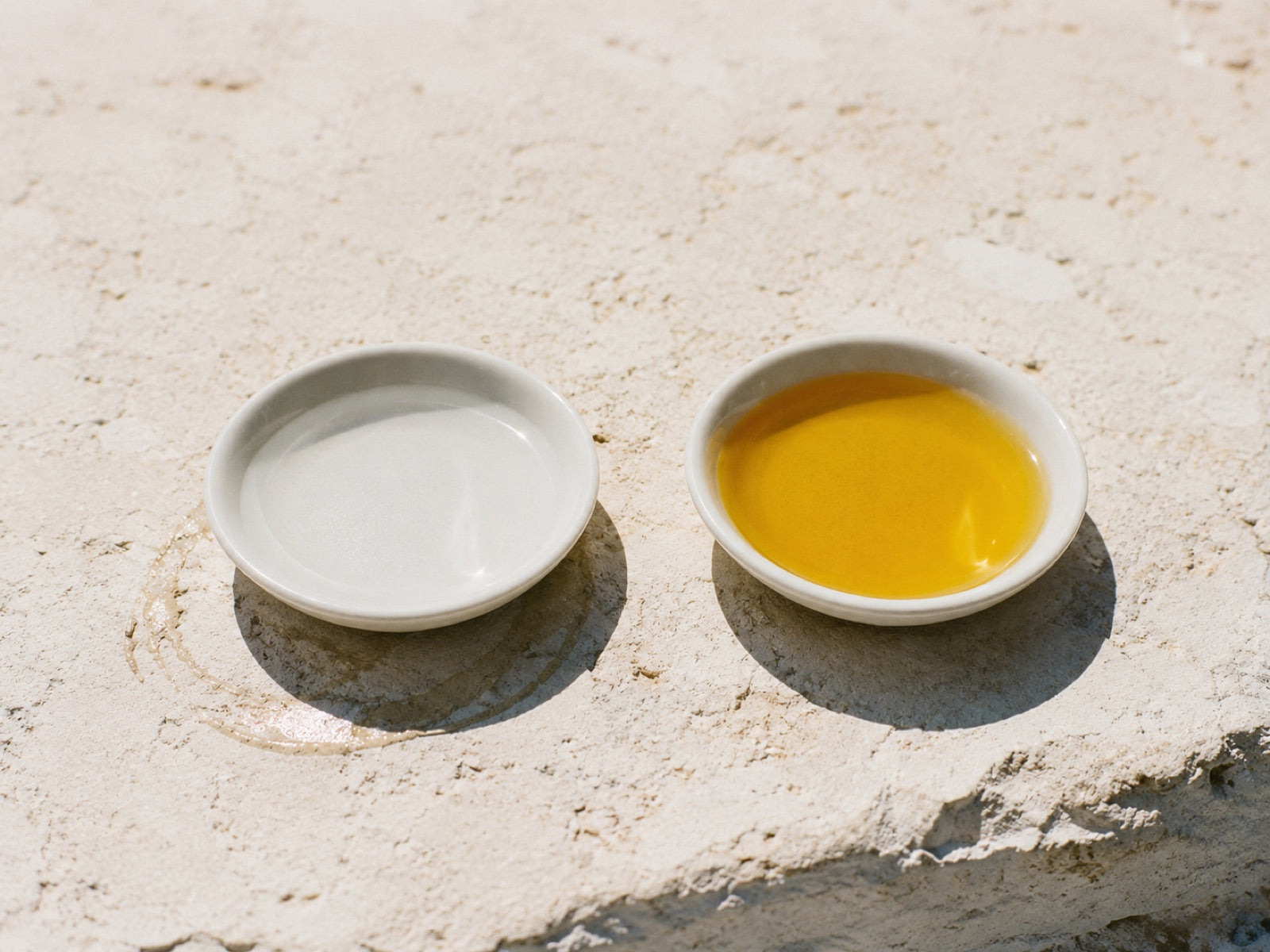
Flip your body lotion over. In the first five lines you will almost certainly find some combination of: water, mineral oil (also listed as paraffinum liquidum), and dimethicone.
Here's what each one is doing. The water delivers an hour of softness and evaporates. The mineral oil, a petroleum by-product costing pennies, wraps your skin in a film that feeds it nothing. The dimethicone smooths the surface silkiness you feel at application, which is the sensation you've been mistaking for skincare since the Carter administration.
None of the three feeds skin. On skin that stopped making its own oil after the change, that's not neutral. That's a hungry organ being handed plastic wrap every night for decades.
A customer whose skin is fixed stops buying
Mineral oil costs almost nothing. Real plant actives cost many times more. And a formula that keeps skin comfortable for an hour, four times a day, sells four times as often as one that changes anything.
Nobody in a lab is cackling about this. It's just economics doing what economics does when nobody makes it behave. The lotion aisle is not going to explain the lotion aisle. Your doctor has ten minutes and bigger fires. So the explanation reaches most women the way it reached me: by accident, at a dinner party, decades late.
What actually happened to your skin after the change

Your skin oiled itself for fifty years. That oil, not water, is what kept it supple, smooth and slow to crease. When the hormones went, the oil went with them, for some women gradually, for many of us like a tap shutting off, which is why whole forums of women describe their arms going crepey "overnight" or "in one summer."
From that day on, every water-based product was answering the wrong question. The question was never "how do I moisten this skin." It was "what replaces the oil that left." In French pharmacies, where the body aisle has been oils for generations, this was never a mystery at all.
What I use now, and what four weeks looked like
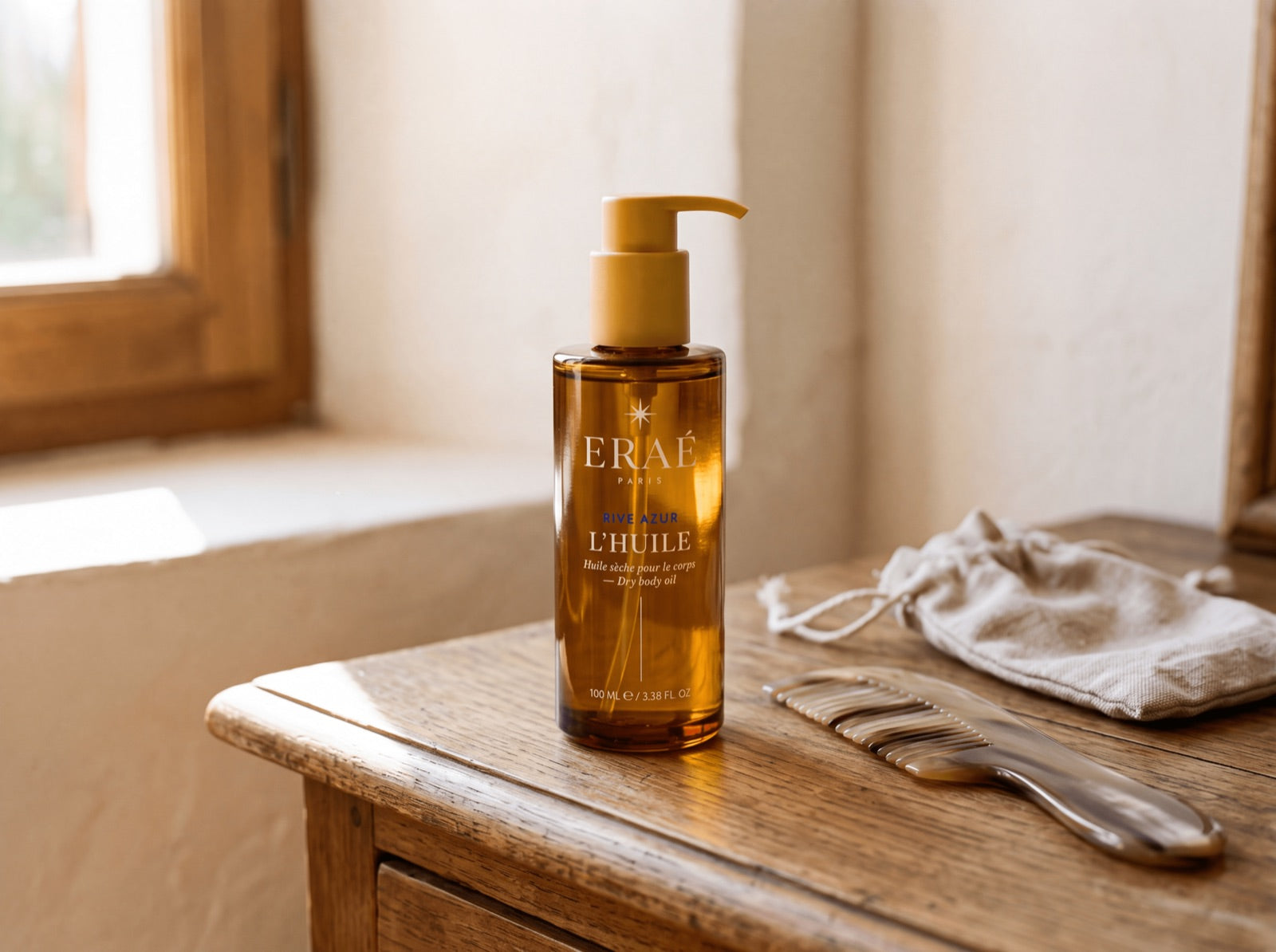
I switched to L'Huile Nº01, a Parisian body oil with no water in it at all. Four plant actives, each replacing something my skin stopped making: bakuchiol for renewal without retinol's sting, camellia as the near-twin of skin's own oil, sea buckthorn for omega-7, evening primrose for GLA. A palmful after the shower, ninety seconds, done.
Week one, it simply went IN, which thirty years of lotion never did. Week three, I pressed my forearm at a red light and the skin pressed back. Week five, I wore short sleeves to my book club and nobody stared, which, if you've been where I was, you know is the entire prize. My knees are still negotiating. Honest is honest.
Rive Azur — L'Huile Nº01. The answer to the right question.
SEE L'HUILE Nº01The decision, laid out plainly
Path one: keep the routine. Another bottle of water and plastic wrap every season, another decade of maintaining the problem at four dollars a week, and arms that keep their sleeves.
Path two: feed the skin instead. Ninety seconds a day, one bottle, thirty days to see it on your own arms, refunded in full if you don't, even with the bottle open and half gone.
Thirty years on path one earned me nothing but a drawer of pump tops. A month on path two gave me back my forearms. That's my whole testimony.
The switch, in numbers
Self-reported results from customer surveys after eight weeks of twice-daily use. Individual results vary.
Thirty days. Even opened. On us.
Path two carries the risk so you don't have to: a month of feeding your skin, refunded in full if nothing changes, no forms, no questions.
DISCOVER L'HUILE Nº01From women who flipped their bottles
★★★★★I did the bottle-flip test at 11pm the night I read this. Water, mineral oil, dimethicone, one two three, exactly as written. I sat on the edge of the tub for a while.
Joan H., 63
★★★★★Thirty-four years of Jergens. THIRTY-FOUR. Six weeks of this oil did what none of them started.
Sandra L., 60
★★★★★My daughter is a nurse and she checked the logic before I ordered. She came back and said, order two.
Ellen R., 57
Before you flip yours
Is every lotion really like this?
Read your own label; it takes thirty seconds and it's the only opinion that matters. Water first, then usually mineral oil or silicones in the first five lines, at every price point. There are honest exceptions. They are rare, and they are almost never in the body aisle.
Why oil instead of a better cream?
Because creams are, by definition, mostly water held together with emulsifiers. The problem is an oil shortage. The format that answers an oil shortage is oil, chosen and built for post-change skin.
What's the risk in trying it?
None that we're allowed to keep: thirty days, even opened, full refund without a form or a question. The only unrefundable thing is another season on the old routine.
Go flip the bottle. We'll wait.
Water. Then, in most homes, mineral oil or dimethicone within five lines. Once you've read it with your own eyes, the last thirty years explain themselves, and the next thirty days become a very easy decision.