Free shipping on orders above $70
Cart (0)
Your cart is empty
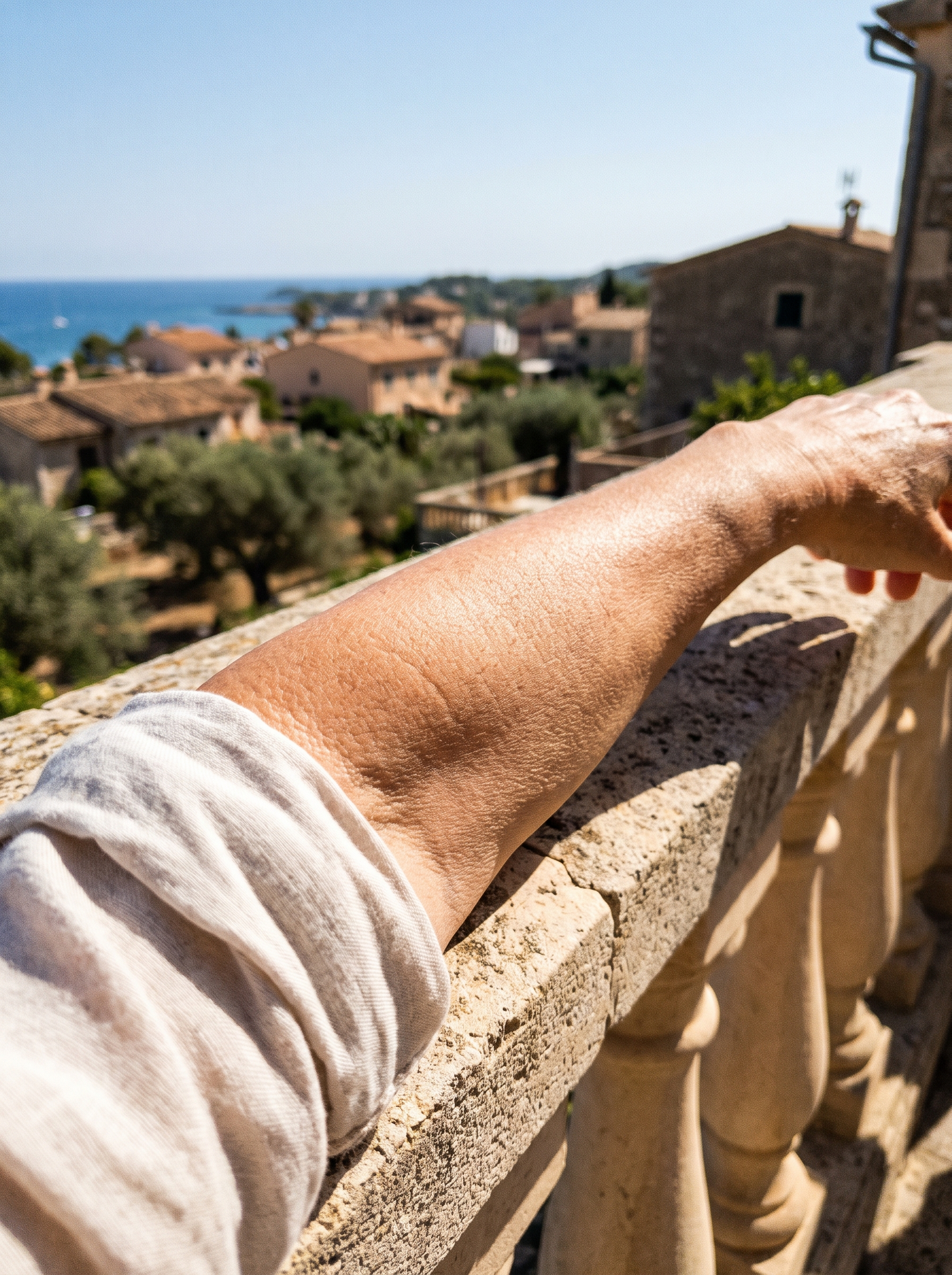
If your arms changed in a single season — not a decade — this page was written for you. If you can name the month it started ("last summer," "between June and August," "about a year ago"), keep reading. If you already own a drawer of firming creams that did exactly nothing, you're about to find out why that was never your fault.
I'm an editor, not a believer by trade. When a reader letter claimed her arms "went crepey overnight" and that a French dry oil turned things around when months of creams couldn't, my job was to pick the story apart. I called an aesthetician with no stake in the ad. I read hundreds of women's own accounts. I checked the label against the claims.
What I found rearranged how I think about skin after 50. The short version: what happened to your arms is probably not aging. It's a collapse. And collapses — caught in time — can be caught.
The sentence I read most often, in almost identical words: "I was fine three months ago." Followed by a doctor or an aesthetician shrugging: just aging. Every woman I read described the same private argument — skin doesn't change like that, that fast. And every one of them was told she was imagining it.
She wasn't. I reached Anne Beaumont, a clinical aesthetician, by phone at her studio outside Aix-en-Provence, and put the question to her plainly: can arms change in a season? "Not from ordinary aging," she said. "Ordinary aging is a slow drip. What these women describe is different — a hormonal shift pulls the support out from under the skin all at once. Under the surface there is a living cushion. When the shift hits, that cushion can give way in months instead of years."
So the first reason no cream worked is the simplest one: everyone was treating slow aging. You didn't have slow aging.
Sudden is not a stronger version of slow. It is a different event. The cells that maintain the cushion go quiet — but quiet is not gone. That distinction is everything.
— Anne Beaumont, Clinical Aesthetician
Here's the kitchen-table version Anne gave me. Most body creams are water thickened with wax. The water evaporates within the hour. The wax stays behind as a film — a raincoat lying on top of the skin. It makes the surface feel softer for an afternoon, which is exactly why you kept buying it, and exactly why nothing underneath ever changed.
A collapsed cushion is not a surface problem. You cannot fix a foundation by painting the walls. What the skin can actually take in is oil — because oil is what skin is made to recognize. No water. No wax. Plant and sea oils close enough to your own that the skin drinks them right in, instead of wearing them like a coat.
One category sits on top. The other goes deep. You spent years paying for the first one. That's not gullibility — that's what the entire American body aisle sells.

Of all the zones women named — legs, décolleté, hands, neck — arms came first, and by a wide margin. Anne's explanation: the skin on the upper arm carries one of the thinnest cushions on the body, it lives in sunlight all summer, and it moves constantly. When the support collapses, the arm has nowhere to hide it. "I don't recognize my own arms" isn't vanity. It's an accurate report.
You can check what's actually happening tonight, for free. Press your thumb firmly into the skin of your upper arm and let go. Watch the mark. If the indent smooths away almost immediately, you're mostly dealing with dryness. If it lingers — if you count past four seconds before the skin recovers — that is structure, not surface. That is the cushion.
Do the test. It costs nothing, and it will tell you more than any label ever has.
One of the accounts that stayed with me came from a fitness instructor in her early sixties: she'd built her working life on her arms, trained daily, and watched the skin change anyway. Another woman wrote that she works out "like crazy, every day" — strong legs, fit body — and the crepe didn't move an inch.
Of course it didn't. Exercise builds the muscle under the skin. It cannot feed the skin itself. They are two different tissues with two different needs, and no number of tricep presses delivers lipids to a cushion that hormones emptied out. The women doing everything "right" and getting nothing back weren't failing. They were pointed at the wrong tissue.
You were handed the wrong tradition — lotion on top, weights underneath, and nothing for the layer that actually changed.
When I pressed Anne on why oil, she didn't quote a study. She told me about her grandmother in Lyon, who kept exactly one bottle on the washstand — a plain glass bottle of oil — and used it on her arms every night of her life. "In France this was never a discovery," Anne said. "Walk the body aisle in any French pharmacy. It's oils. It has always been oils."
American women moisturize. Frenchwomen feed. The habit sounds cosmetic until you understand Reason Nº2 — then it reads like the whole answer, hiding in plain sight on another continent's shelves.

Here is where my research stopped being abstract. When I asked Anne what a bottle would need to actually answer a sudden collapse, she counted on three fingers. Wake the quiet cells. Shield what they build. Rebuild the lipids the hormonal shift stripped out. One job — "moisturize" — was always going to fail, because the problem was never one job.
Then I went looking for a label that did all three, and kept arriving at the same one: the letter-writers' oil, Eraé Paris — a house that refused the "firming cream" category outright and built its dry body oil, RIVE AZUR L'HUILE, around the collapse itself. Four plant-and-sea-derived heroes, each with one clear job: bakuchiol, for renewal without the sting or sun-sensitivity of retinol; camellia japonica seed oil, a near-twin of the skin's own oil, so the barrier accepts it instead of wearing it; sea buckthorn, rich in omega-7; evening primrose, whose GLA rebuilds the exact lipids midlife skin loses.
Morning and night, on clean skin. That's the entire ritual. No water, no wax, nothing to sit on top.
Two honest lines before we go further. First: if your skin hangs in loose folds — after major weight loss, or on a GLP-1 medication — that is lost volume, and volume is a conversation for a doctor, not a bottle. What an oil can address is the texture riding on top of your arms: the crepe. Second: I can't verify the coworker-and-Paris-pharmacy story in whatever ad brought you here, and I won't pretend I can. What I can verify is the label, the mechanism, and the women I read. That part checks out.
This is the reason that made me publish. When collapse comes suddenly, the deeper cells don't die — they go dormant. Anne was blunt about the difference: dormant cells can be woken. But dormancy has a horizon. Wait long enough and the quiet becomes permanent, and everything gets much harder.
Which means the question that matters is not the one on your driver's license. It's this: how long ago did it start? If you're still counting in months — even fourteen, even sixteen — you haven't missed it. If you're counting in years, start tonight anyway; partial recovery still beats none. But the woman with the widest-open door is the one reading this in her first shocked year, drawer full of failed creams, still angry.
That anger is correct. Point it at the calendar, not at yourself.

Figures above reflect Eraé Paris's published customer research and guarantee terms; the 396 accounts are the brand's verified confessional-quote corpus, which this editor reviewed.

Morning and night, on clean skin. Most women begin with the multi-bottle ritual for one reason: the window is measured in months, and so is the work.
Check AvailabilityOne thing before you click, because a stranger pushing you is part of how you got here: don't buy this on my say-so. Read the label. Do the four-second press on your own arm tonight. If the mark lingers, you'll know exactly why creams failed and what the alternative is.
And know this going in: some women notice the change in a few weeks. Some take a full season. A few see little — skin is personal. That range is precisely what the thirty days exist for.
Use the bottle. Actually use it — morning and night, on the arms that made you stop waving. If after thirty days you don't see what you hoped for, send it back half-empty and Eraé Paris refunds you. No photographs required, no interrogation. Thirty days. Even opened. On us.
They can afford that promise for an unglamorous reason: women who feel a real change don't ask for their money back, and the brand would rather lose a bottle than keep a doubter.
From here there are two calendars. On the first, nothing changes: the cardigan in July, the cropped photos, another cream in the drawer by Christmas, and the months quietly turning into years. On the second, tonight's application is simply the day the counting stopped working against you.
Nobody can make that choice for you, and this page won't pretend to. But you came here because something in you never accepted "just aging." That instinct has now been confirmed by everyone I interviewed. The only question left is which calendar starts tomorrow.
How fast will I see something? Honestly: it varies. Some women report softer, denser-feeling skin within weeks; for others the shift comes over a full season; a few see little. The thirty-day guarantee exists so that range costs you nothing.
Is it only for arms? No. Arms are where sudden collapse shows first, but women use the same ritual on legs, décolleté, stomach, hands, and neck.
My skin reacts to everything — especially retinol. That's why the renewal hero here is bakuchiol, not retinol: the wake-up effect without the sting, and no added sun-sensitivity on summer arms.
Why an oil over a cream at half the price? Because you've already run that experiment. A film that rents you an afternoon of softness is expensive at any price; food the skin actually takes in is the only version worth paying for once.
And if nothing happens for me? Then it costs you nothing. Thirty days, even opened, fully refunded. That's the whole policy, and it's the last line of it.
Eleven creams in two years. Eleven. I ordered this angry, fully expecting to return it. Around week four I pressed my thumb into my arm the way the article said — and the mark let go before I finished counting. I sat on the edge of the tub and laughed.
— Karen S., 58I dress for work ten minutes after I put it on. Nothing on my clothes, no film on my skin — it just disappears in, which I now understand is the entire point. The two-minute morning and night habit was easier to keep than any cream routine I've owned.
— Debra H., 61It started the summer before last, and I nearly didn't order because I thought I was too late. I wasn't. My arms are not where they were at 50 — but they are visibly, touchably better than in March, and I wore short sleeves to my sister's birthday. If you're counting in months, don't waste another one deciding.
— Pat W., 63THIS IS AN ADVERTISEMENT AND NOT AN ACTUAL NEWS ARTICLE, BLOG, OR CONSUMER PROTECTION UPDATE
THIS IS AN ADVERTISEMENT AND NOT AN ACTUAL NEWS ARTICLE, BLOG, OR CONSUMER PROTECTION UPDATE. This page is Sponsored Advertising Content published on behalf of Eraé Paris. Accounts reflect individual experiences; results vary from person to person and are not guaranteed. This product is a cosmetic and is not intended to diagnose, treat, cure, or prevent any disease. If skin changes concern you, consult a physician.