Free shipping on orders above $70
Cart (0)
Your cart is empty
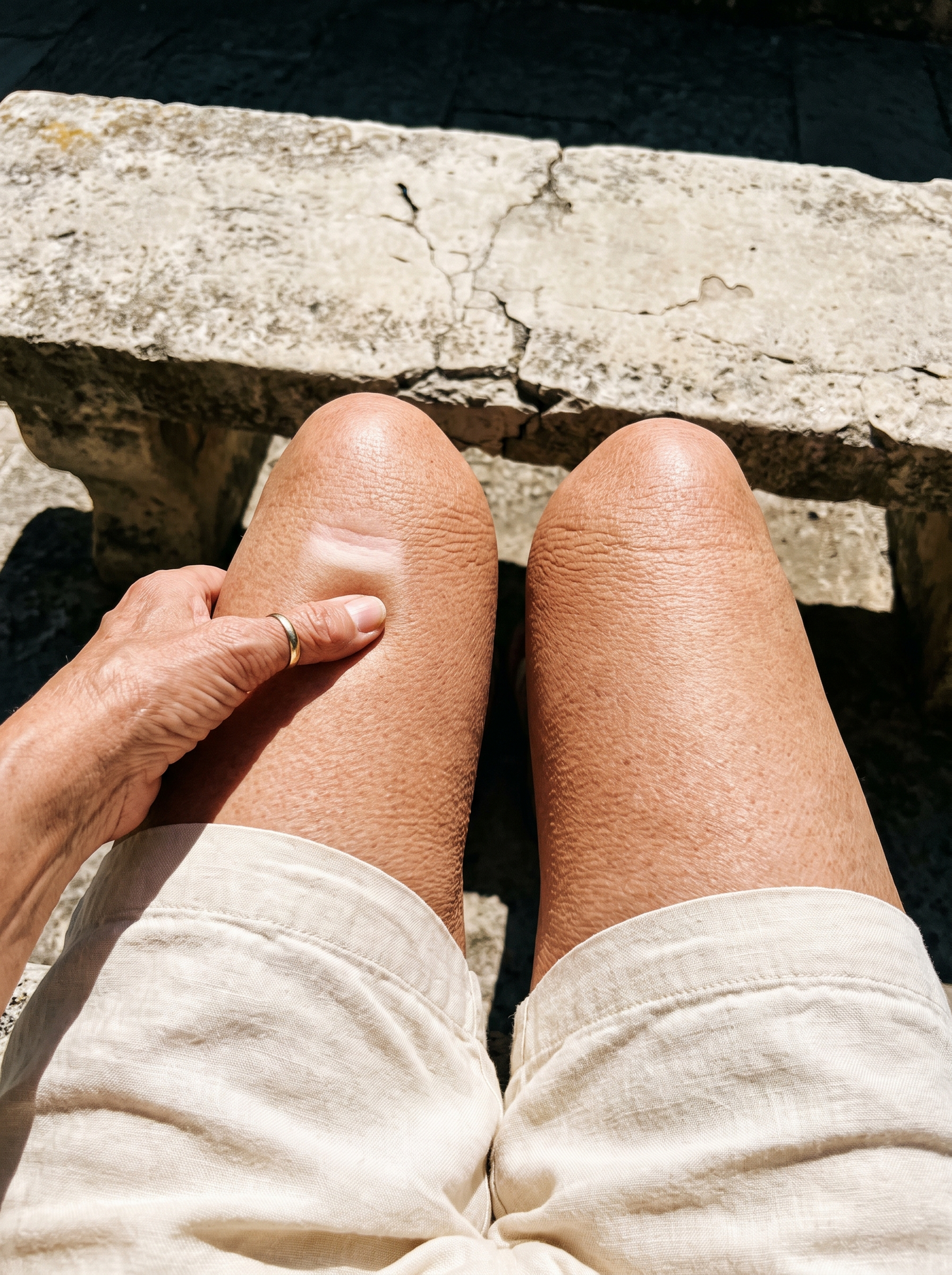
There is a folder on this desk that did not exist a year ago. It holds reader letters — and nearly all of them are about knees. Not faces. Not hands. Knees. And nearly every letter can name the season it started: “last summer.” “Between June and August.” “I turned 50 and the next day saw I had wrinkly knees.”
If the skin above your knees went crinkled and papery within a single season — if you have quietly retired your shorts, your above-the-knee dresses, your place at the pool — if a doctor shrugged and said “just aging,” and some part of you refused to believe it — this page was assembled for you.
We took that folder to a clinical aesthetician, and we kept asking questions until the answers held. Here are the seven that mattered. The short version: your knees did not age on schedule. Something underneath them gave way. And for a limited stretch of time, it answers back.
When the skin over a knee crinkles in one season, I don't think 'aging.' I think 'collapse.' Different cause. Different clock. Different fix.
— Anne Beaumont, Clinical Aesthetician
Ordinary aging is slow. Skin loses roughly one percent of its collagen a year — a pace so gentle you never catch it happening. That is not what the letters describe. The letters describe a cliff. “Just about shrieked at the sight of my legs in the garden today,” one reader wrote. “Dry and pleated.” Another: “My knees for Pete's sake! Can't I at least have good knees?”
Here is what we learned when we brought the folder to Anne Beaumont's consulting room. Around the hormonal shift, some women lose two to three years' worth of that support in a matter of months. It is a different event from aging — sudden, steep, and datable. Which is exactly why you can date it.
So when a doctor says “it's your age,” he is being technically true and practically useless. Your instinct — this came too fast to be normal — was the correct diagnosis all along. You just never got credit for it.
Under younger skin there is a kind of cushion — the fed, full layer that keeps skin lying smooth over a knee. When the hormonal shift arrives, that cushion can thin faster than the surface above it can keep up. The skin hasn't stretched. It hasn't dropped. It has lost the thing beneath it that kept it smooth — so it crinkles, like fabric with nothing behind it.
That single sentence explains almost every letter in the folder. Why fit women get it (“I do squats, ride the stationary bike — and still, at 61”). Why thin women get it. Why it shows above the knee first, where skin folds ten thousand times a day over a cushion that is no longer there.
You can check this tonight, for free. Press your thumb firmly into the skin above your knee for three seconds. Let go and count. If the indent lingers four seconds or more, the surface has nothing beneath it holding shape. Under two seconds, the cushion is still fed. Do it now — the rest of this page will make more sense.

Read the back of any firming jar in your drawer. First ingredient: water. Second: usually a wax or a silicone. A cream is a film — it sits on the surface, feels lovely for a morning, and is gone by lunchtime. It never reaches the layer that actually thinned. One reader put it perfectly: “a glorified moisturizer and nothing more.” Another applied a well-known crepe lotion “liberally, all over” — and still wrote to us about her knees.
So hear this clearly: the jars did not fail because you used them wrong, or too little, or too late. They failed because you cannot fill a cushion from the outside with water and wax. You were handed the wrong tradition — a face-cream habit exported to a structural problem it was never built to solve.
Which raises the obvious question: what does the right tradition look like?
One of our editors stood in a pharmacy in Antibes this spring and photographed the body-care shelf out of sheer disbelief. Row after row of oils. Almost no lotion in sight. The pharmacist found the question strange: “A lotion is water. Water evaporates. Why would you feed skin something that leaves?”
That is the split in one line. American women moisturize; Frenchwomen feed. A cream comforts the surface for a few hours. A true dry oil is made of things skin recognizes as food — it sinks past the surface instead of filming over it. For a woman whose cushion has emptied, that distinction is not cosmetic philosophy. It is the whole game.

The oil that keeps surfacing in our reader letters — the one Frenchwomen over fifty quietly pass between themselves — is Eraé Paris. What made us take it seriously is not the accent. It is the architecture. It was not designed as “a moisturizer, but richer.” It was designed backwards from the collapse itself, in three movements.
Wake. Bakuchiol — a plant-derived alternative to retinol — nudges the skin's renewal back into motion, without the sting or the sun-sensitivity that makes retinol miserable on legs. Shield. Camellia oil is a near-twin of skin's own oil, so skin drinks it straight in rather than letting it sit on top. Rebuild. Sea buckthorn, rich in omega-7, and evening primrose, rich in GLA, flood back the very lipids midlife strips out of papery skin.
No water. No wax. No fillers. Four plant-and-sea-derived oils, one minute a night, worked into the skin above the knee. Whatever you end up buying — this or anything else — we'd urge you to hold it to the same standard:
This is the part the folder of letters made urgent. The cells that rebuild the cushion do not die when the collapse hits — they go quiet. Dormant, not dead. And they answer back fastest in the first eighteen to twenty-four months after the change begins. That is the window. It is real, it is generous, and most women spend it in the cream aisle.
If you can still name the season your knees changed — “last summer,” “about fourteen months ago” — you are almost certainly still inside it. That is the only urgency on this page. There is no countdown clock here, and there never will be. The clock that matters is not ours. It's yours.
One practical note, plainly stated: the oil is made in small batches and does periodically sell out. That is a fact of small-batch production, not a sales tactic — but paired with a window measured in months, it is worth knowing.

We would not print this page without this section. If your skin is hanging — loose folds from major weight loss, from GLP-1 medication, from pregnancy — that is a volume problem, and it belongs in a doctor's office, not a bottle. An oil feeds the papery, crinkled texture riding on top of skin. It does not remove folds of skin. Anyone who tells you otherwise is selling you your next disappointment.
And even within its lane, honesty requires a range: some women feel the paper leave the skin within a couple of weeks. Most see the look of the knee change over a month or two of nightly use. A few see little. We cannot tell you which group you'll be in — nobody honestly can — and that, precisely, is what a sixty-day guarantee is for.
Collapse and window figures per the Eraé protocol notes; formula and guarantee terms taken directly from the brand's order page.

One bottle, $59 — a one-minute nightly ritual for the skin above your knees. Multi-bottle sets exist for one reason only: the window is measured in months, and the ritual should be too.
Check AvailabilityHere it is, in full: use the oil on your knees, every night, for up to sixty days. If the skin doesn't feel like your own again, send the bottle back — opened, half-empty, it doesn't matter — for every dollar. No forms. No questions. Sixty days. Even opened. On us.
The brand can afford to talk this way for a plain reason: a woman who feels the paper leave her skin does not ask for her money back. The guarantee isn't generosity. It's confidence, priced in.
I'd bought everything — the crepe lotions, the gold-lidded one, the pharmacy tubes. All water, I know that now. I gave this oil the same two weeks I'd given all of them, fully expecting nothing. By week three the skin above my knees stopped looking pleated when I got dressed in the morning. That drawer of jars cost me more than three of these bottles.
— Marianne K., 63Two weeks in, I felt softness but saw nothing, and I nearly sent it back. Week seven, kneeling in the garden in shorts, I looked down and the skin over my knee was lying flat instead of gathering. I'm the slow group they warn you about on this page. I'm glad the sixty days were long enough for me to be slow in.
— Paula R., 57My knees changed the summer before last, so by the time I read about the window I was sure I'd missed it. I almost didn't order out of spite. What I got back wasn't everything — I won't pretend it was — but it was enough to wear a skirt to my grandson's christening without thinking about my knees once. If you're late like I was: late is not the same as never.
— Carol D., 61How fast will I notice anything? Feel usually comes first — many women describe the skin feeling less like paper within a couple of weeks. The look of the knee changes more slowly, typically over a month or two of nightly use. Some take longer. A few see little. The sixty days exist so that every one of those outcomes costs you nothing.
My arms and décolleté went papery too. Same thing? Usually, yes — the same cushion collapse shows up wherever skin folds over thinning support: arms first for most women, then legs, chest, hands. The ritual is the same oil, the same minute, wherever the paper is.
I can't tolerate retinol. Can I use this? That intolerance is exactly why bakuchiol is in the formula instead — renewal without the sting or the sun-sensitivity, which matters on legs you'd like to actually put in the sun.
Is $59 justified for one bottle? We'd answer with arithmetic, not adjectives: count what the drawer of jars cost you, and what it delivered. One reader's tally came to over $400 of water and wax. This is one bottle, four oils that actually reach the problem, and a refund if they don't.
What if it simply doesn't work on me? Then you send it back inside sixty days — opened, used, nearly empty — and you're refunded in full, no forms, no questions. You are not gambling $59. You are running a sixty-day test on your own knees, and the house covers the losing outcome.
Not our word for it — your own skin's. Three seconds of pressure just above the knee, then count. If the indent snaps back in under two seconds, close this page. Truly. You don't need us, and a stranger pushing you toward a bottle is how you ended up with a drawer of jars in the first place.
But if it lingers — four seconds, five — then you already know what the letters in our folder know: the cushion has emptied, the creams were never going to reach it, and the months in which it answers back are passing whether you act or not.
Two paths from here, and both are honest. Keep the knees covered and let the window close on its own schedule. Or spend one minute a night feeding what emptied, with sixty days to be wrong at no cost. Your next summer is a decision. Make it while it's still yours to make.
THIS IS AN ADVERTISEMENT AND NOT AN ACTUAL NEWS ARTICLE, BLOG, OR CONSUMER PROTECTION UPDATE
THIS IS AN ADVERTISEMENT AND NOT AN ACTUAL NEWS ARTICLE, BLOG, OR CONSUMER PROTECTION UPDATE. This page is Sponsored Advertising Content published on behalf of Eraé Paris. The accounts, letters, and testimonials on this page reflect individual experiences; results vary from person to person and are not guaranteed. This product is a cosmetic and is not intended to diagnose, treat, cure, or prevent any disease. If a sudden skin change is accompanied by other symptoms, consult your physician.