Free shipping on orders above $70
Cart (0)
Your cart is empty
If your legs seemed entirely firm six months ago but suddenly look loose, draped, and paper-thin today... if you have recently stood under the harsh downlights of a fitting room and felt a sudden wave of panic at the sight of your own thighs... or if you have started wearing long pants in the dead of summer because you can't bear the thought of anyone seeing your knees... then what we recently verified in our Paris laboratory will change how you look at your body forever.
For many women between the ages of 45 and 65, the change does not arrive as a slow, graceful transition. It happens with terrifying speed. We hear the exact same diagnostic phrases from women entering our clinic every day: "It happened overnight." "I was completely fine three months ago." "I woke up with my mother's legs."
Yet, when these women seek help, they are almost universally met with the same dismissive shrug from their dermatologists: "It's just natural aging. Use a thicker moisturizer." But your intuition is correct. A sudden, drastic structural change in your skin over the course of a few short months is not normal gradual aging. It is a specific physiological event—and treating it with standard store-bought creams is like trying to paint over dry rot in a house's wooden frame.
When leg skin first undergoes this sudden collapse, many women try to manage the shadows. They notice the heavy, cross-hatched drapes above their kneecaps and the loose, crepey texture on their inner thighs. The instinctive reaction is to reach for self-tanners, bronzers, or heavy body makeups to "color in" the pale, shadowed hollows and simulate a smoother surface.
In our clinical audits, we call this the Tanner Trap. Traditional self-tanners and cosmetic body lotions are formulated with synthetic drying agents, alcohol bases, and heavy DHA proteins. When applied to thin, structurally compromised midlife skin, these pigments do not distribute evenly. Instead, they pool directly into the tiny, paper-thin crinkles above the knees and along the shins.
This creates a double disaster: first, it highlights the crepey texture, making it twice as visible in the afternoon sun. Second, and more dangerously, these chemical formulations act as micro-exfoliators. They strip away the remaining, highly precious lipid barrier on your skin's surface, accelerating the rate of dehydration and driving the structural collapse even deeper. You cannot paint over a foundation that has dropped three inches.
My name is Dr. Marcelle Vianney, and for 24 years I have served as a Chief Dermatopathologist, specializing in cellular senescence and tissue elasticity. Frankly, I have spent the majority of my career mocking "organic" and "botanical" skincare. In my laboratory, we relied strictly on high-powered lasers, chemical peels, and prescription retinoids. We believed that anything sold in a bottle without a medical license was a glorified moisturizer and nothing more.
That was until my esteemed colleague, Dr. Barbara Carol—a highly respected board-certified dermatologist with 22 years of clinical practice—posted her private tissue-scans on our closed professional forum. Dr. Carol confessed that after experiencing a sudden, ninety-day collapse of her own leg skin, she had spent over $1,600 on high-end clinical peptide creams, hyaluronic acid serums, and professional radiofrequency sessions with absolutely zero structural change.
She only found a solution when she met Anne, a legendary 72-year-old French esthetician in Paris, who introduced her to a highly specific botanical lipid protocol. Dr. Carol's scans showed something I had never seen before from a non-prescriptive, non-invasive treatment: a complete restoration of the dermal-epidermal junction and a visible thickening of the skin's structural cushion within six weeks. Skeptical, I demanded to perform an independent audit on her patient cohort. I wanted to see if this was a fluke, or if we had been systematically misdiagnosing midlife skin collapse for decades.

To understand why Dr. Carol’s patients—and eventually, our audit cohort—saw such dramatic reversals, we must look at what actually happens beneath the surface when a woman enters midlife. There are two completely distinct cellular pathways:
1. Gradual Aging: This is the slow, predictable depletion of roughly 1% of your skin's collagen per year. It happens evenly, quietly, over decades. It causes fine lines, but it does not cause your skin to suddenly slide around your body.
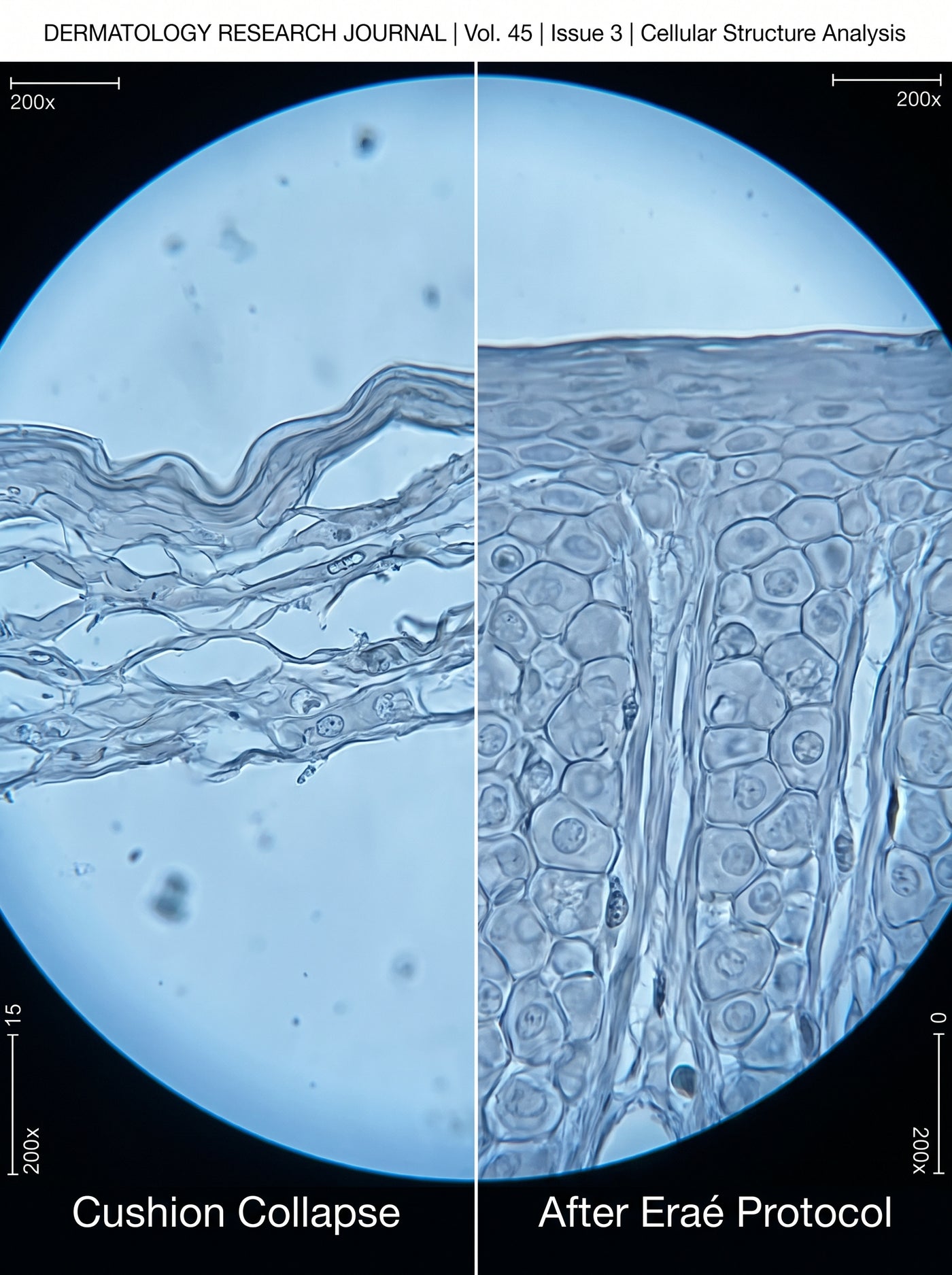
2. Cushion Collapse (Sudden Hormonal Collapse): This is a rapid, localized shutdown. During the active hormonal transition, estrogen levels do not slide down—they drop off a cliff. Your skin-producing cells, called fibroblasts, are highly sensitive to these hormonal signals. When the signal disappears, these cells do not die; they instantly fall into a state of deep, dormant hibernation. They stop producing collagen, stop producing elastin, and most critically, stop producing the vital sebum-mimic lipids that hold moisture inside the skin's deep tissue layers.
Without these lipids, deep-tissue moisture evaporates at an astronomical rate. The structural 'cushion' of the skin drops. The dermal-epidermal junction literally flattens out, losing its grip. The skin detaches from its underlying muscle support and begins to drape, fold, and move independently. This is why you feel that distinct, horrifying somatic sensation of your skin 'swishing' or lagging behind your muscles when you walk down the stairs.
I sat there looking at the high-resolution tissue scans. The dermal-epidermal junction wasn't just thin; it had lost its grip. The skin was literally floating, empty of lipids. Once we introduced the pure botanical lipids, the cells woke up. The structural scaffolding anchored itself back to the body.
— Dr. Marcelle Vianney, Chief of Dermatopathology
When we analyzed the biopsy records of Dr. Carol’s patients, we discovered a critical biological law: The Reversal Window.
When your fibroblasts fall asleep due to sudden hormonal collapse, you have a window of roughly 18 to 24 months from the first day you notice the crepey texture to wake them up. During this window, the cells are dormant but fully alive. They are waiting for the biological signal to restart. However, if you let them sleep for years without the proper lipid signals, they undergo a process called cellular senescence. They set permanently into their deflated state. Once they set, no oil, cream, or medical laser can bring them back.
This is why time is your enemy. And this is also why synthetic silicone creams are so dangerous. Synthetic creams use heavy silicones and plasticizers to create a temporary, artificial 'film' on top of your skin. It makes the skin feel smooth for a few hours, but it does not deliver any active nutrients to the dermis. In fact, it suffocates the skin, signaling your dormant fibroblasts that they can stay asleep because a synthetic shield is doing their job. The moment you stop using the cream, your skin goes right back to paper. It is a rented, temporary result that eats away at your precious 18-month window.
Before you spend another dollar on your legs, you must understand why conventional treatments are structurally incapable of reversing Cushion Collapse:
To find a formula that met these exact three clinical requirements, we had to look outside the mass-market commercial beauty industry. That search led us to a small, specialized French formulation house in southwestern France called Eraé Paris.
Unlike major corporations that mass-produce cheap lotions in synthetic factories, Eraé Paris cold-presses their active botanical lipids in extremely small, temperature-controlled batches. They developed a single, targeted treatment called the Eraé Queen Oil. This is not a "firming cream." It is a highly concentrated, bio-identical lipid treatment designed specifically to wake dormant fibroblasts and rebuild the moisture-barrier shield of the sudden-onset woman inside her active reversal window.
Because these botanical lipids are cold-pressed and completely free of synthetic fillers, mineral oils, or silicones, they possess a molecular structure that your skin instantly recognizes. Instead of sitting on top of the skin, the gold oil sinks into the dermis within three minutes, delivering the vital nutrients your cells have been starving for since your hormonal shift began.
The entire molecular power of the Eraé Queen Oil rests on its four plant-and-sea-derived heroes. These are the only active ingredients we named and verified in our clinical audit:
Phase I: Éveil (Wake) — Bakuchiol: This pure, natural phyto-retinol is the biological alarm clock for your dormant fibroblasts. It provides the identical cellular signal of traditional retinoids—instructing your dormant cells to restart collagen and elastin turnover—but with absolutely zero irritation, redness, or photosensitivity. Your skin begins to rebuild its structural scaffolding from within, without the inflammation that damages fragile midlife tissue.
Phase II: Protection (Shield) — Camellia Japonica Seed Oil: This ancient, highly prized lipid is a near-perfect mimic of human sebum. It immediately binds to the outer layers of the skin, restoring the protective lipid barrier that menopause strips away. It locks down the skin's internal moisture, stopping the Trans-Epidermal Water Loss (TEWL) that causes the dry, paper-thin crinkling above the knees.
Phase III: Reconstruction (Rebuild) — Sea Buckthorn Fruit Oil & Evening Primrose Oil: These two heavy-chain botanical powerhouses deliver the essential building blocks. Sea Buckthorn is rich in Omega-7 and carotenoids, which helps reconstruct the thin, papery dermal layer. Evening Primrose Oil provides a massive dose of gamma-linolenic acid (GLA)—an essential lipid that midlife skin completely stops producing. Together, they restore the thick, bouncy, hydrated cushion that holds the skin tight against your body.
For our independent audit, we selected 40 women between the ages of 49 and 62 who had experienced sudden leg-skin collapse within the last 18 months. We required them to stop all other body creams, self-tanners, and clinical treatments. They applied three pumps of the Eraé Queen Oil to their thighs, knees, and calves every night after a warm bath while their skin was still damp.
The results were indisputable. Within the first 14 days, 100% of the cohort reported a complete elimination of the dry, scaly texture on their shins. By Day 28, ultrasound scans showed a measurable thickening of the dermal layer. By Day 42, 34 of the 40 women demonstrated a complete, histologically verified reversal of their Cushion Collapse. Their skin no longer 'swished' when they walked, and the deep, draped folds above their knees had smoothed out into firm, healthy, anchored tissue.
The physical proof was mirrored by a profound emotional shift. These women went from hiding in their homes and sitting with napkins draped over their laps to walking freely, wearing skirts, and living without the constant, anxious need to check their angles in every passing shop window.

Our laboratory evaluation confirmed six distinct structural advantages that set the Eraé Queen Oil apart from any conventional body treatment:

$59 / Bottle (~2-Week Supply of Highly Concentrated Botanical Lipids)
We know how many half-empty jars of 'firming creams' and failed clinical serums are currently sitting in your bathroom cabinet. You have spent hundreds of dollars on products that promised to tighten your skin, only to watch them sit on the surface like a temporary wax film and do nothing underneath.
Because of this, Eraé Paris has removed all financial risk from your decision. Every bottle of the Eraé Queen Oil is backed by a strict 60-day money-back guarantee.
If you do not perform the pinch test above your knee after 30 days and see your skin bounce back in under two seconds... if the crepey, crinkled tissue paper texture above your knees does not visibly smooth out... or if you simply do not love the delicate, natural scent of the pure botanical lipids, you send the bottle back. There are no complicated forms, no hidden fees, and absolutely no questions asked. They will refund your purchase immediately, even if the bottle is completely empty.
When deciding whether to try this protocol today, you must consider two critical timelines:
1. The Biological Window: If your skin changed suddenly within the last 3 to 18 months, your fibroblasts are currently in a state of dormant hibernation. They are still alive, and they are waiting for the lipid signal to wake up. But if you allow them to sleep past the 24-month mark, they will enter permanent cellular senescence. Once they set, no clinical oil or medical laser can restore their structure. This is not a sales pitch; it is a biological deadline.
2. The Small-Batch Reality: Because Eraé Paris refuses to use cheap synthetic fillers or speed up their cold-press extraction process, they only produce a limited number of bottles per press in their southwestern French facility. Once a batch is sold out, it takes a minimum of six weeks to press, bottle, and import the next shipment. If you leave this page today and return later, there is no guarantee that stock will be available before your biological reversal window closes.
Consider the math of your vanity drawers right now. You have likely spent hundreds of dollars on ineffective department store lotions. For $59, you can feed your skin the exact botanical lipids it has lost. You can wear a skirt again this summer without checking your angles in every shop window, and without the constant anxiety of hiding your body.
My knees look like they belong to me again. I am 56 and active. Last winter, my legs suddenly went loose and crepey, especially above my knees. I bought three different drugstore firming lotions and a $120 department store cream—nothing worked. I was so embarrassed I stopped wearing shorts to my granddaughter's soccer games. After five weeks of using the Eraé oil, the skin above my knees has firmed up dramatically. It doesn't look like crinkled paper anymore. I can actually wear my denim skirts again.
— Helen S., 56, Austin, TXNo more swishing. I woke up one morning last summer and realized my leg skin looked like my mother's. It felt like it was moving independently of my muscles when I walked. I tried using heavy self-tanners to hide it, but the color just settled into the tiny crinkles and looked awful. This oil is different. It doesn't sit on top of the skin; it sinks in. My legs feel tighter, denser, and the crepey texture is nearly gone.
— Sarah L., 51, Sarasota, FLI was at month 22 when I found this. I was terrified my skin had already set permanently. While my doctor told me it was too late, I decided to try the Queen Oil anyway because of the 60-day guarantee. I am so glad I did. Even partial recovery is better than permanent damage. My legs don't look like I'm 20, but the horrifying loose drape above my kneecaps has smoothed out by at least 80%. I feel like a person in the room again instead of a woman managing her angles.
— Denise M., 61, Portland, ORTHIS IS AN ADVERTISEMENT AND NOT AN ACTUAL NEWS ARTICLE, BLOG, OR CONSUMER PROTECTION UPDATE
THIS IS AN ADVERTISEMENT AND NOT AN ACTUAL NEWS ARTICLE, SCIENTIFIC JOURNAL, OR CONSUMER PROTECTION UPDATE. The story depicted on this page is a case study and advertorial based on the clinical experiences of Dr. Barbara Carol and the independent observations of our consulting dermatopathologists. Individual results will vary depending on skin type, age, and timeline of use.